Best Flooring for Condos in Toronto (2026 Buyer's Guide)
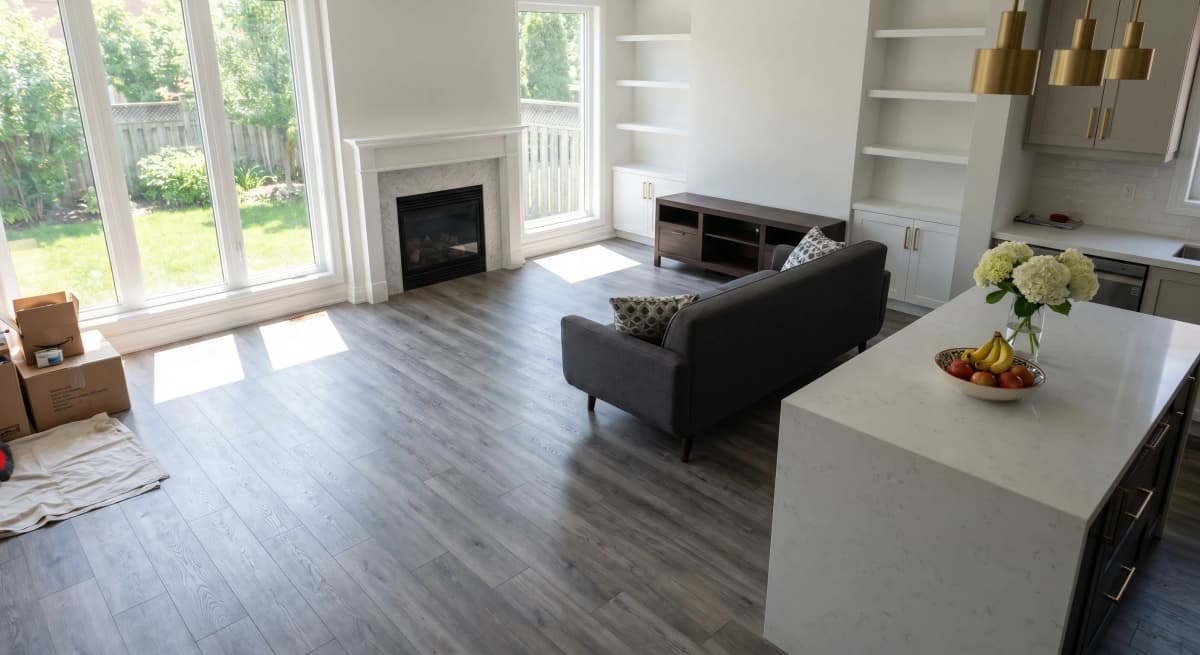
The best flooring for Toronto condos is SPC vinyl plank or engineered hardwood — but which one depends on your building's noise rules, your subfloor condition, and your budget. Most Toronto condo boards require flooring with a minimum IIC 50–55 and STC 50–55 rating, which rules out solid hardwood nailed down and most glue-down installs. What's left is a short list of floating-floor options, and this guide ranks them honestly.
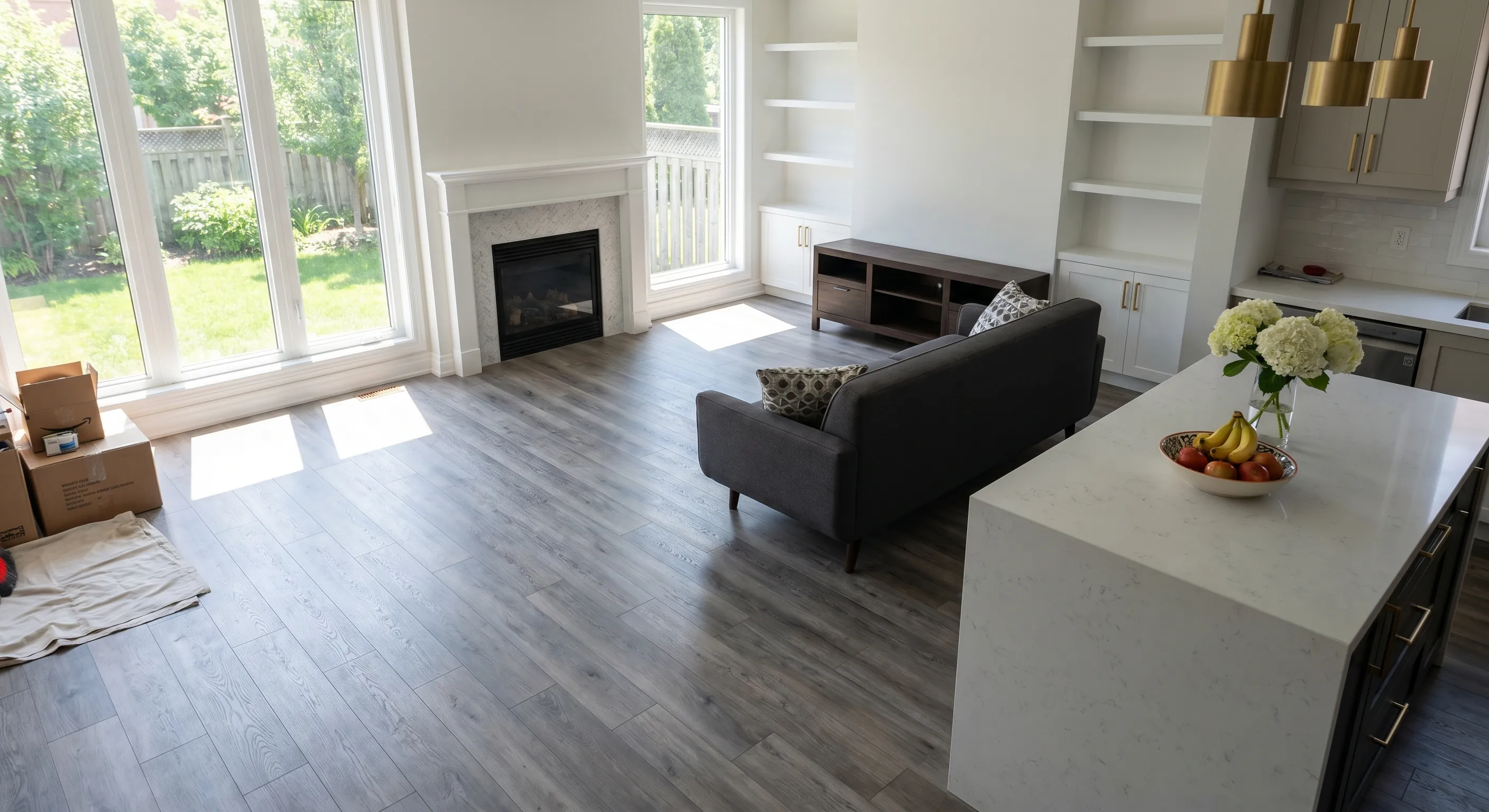
Why Condo Flooring Rules Are Different From Houses
In a detached home, you pick the floor you want and install it. In a Toronto condo, you're sandwiched between neighbours — the person below you can hear every footstep, every dropped fork, every chair scrape. That's why condo corporations set acoustic minimums, and most management offices will ask for a spec sheet before approving your renovation permit.
The two ratings that matter:
- IIC (Impact Insulation Class): Measures how much impact noise (footsteps, dropped objects) transfers through the floor. Higher = quieter for the unit below. Most Toronto condo boards require IIC ≥ 50, some premium buildings require IIC ≥ 55.
- STC (Sound Transmission Class): Measures airborne sound (voices, TV). Minimum STC 50 is standard in most Toronto high-rises built after 2000.
The practical implication: you almost always need a floating floor with an underlayment rated to meet those thresholds. Nail-down solid hardwood is out. Glue-down without acoustic membrane is out. This is non-negotiable — fail an inspection and you'll be ripping it up at your own cost.
Check our installation services page for details on how we handle condo permit documentation and spec sheet submissions.
The 4 Real Options for Toronto Condo Floors
Once you filter for floating installation and acoustic compliance, four materials survive the cut. Here's the honest breakdown:
| Material | Cost (material only) | Waterproof? | Acoustic Performance | Best For |
|---|---|---|---|---|
| SPC Vinyl Plank | $2.50–$5.00/sqft | ✅ 100% waterproof | Good with attached pad; IIC 50–54 typical | Budget-conscious buyers, rentals, kitchens |
| Engineered Hardwood | $4.50–$9.00/sqft | ❌ Not waterproof | Excellent with acoustic underlay; IIC 52–58 | Owners wanting resale value, living/dining |
| Laminate | $1.80–$4.00/sqft | ⚠️ Water-resistant only | Moderate; IIC 48–53 with quality underlay | Dry areas, short-term ownership |
| Luxury Carpet | $2.00–$6.00/sqft | ❌ Not waterproof | Best acoustic performance; IIC 55–65 | Bedrooms, noise-sensitive units |
Which should you pick?
- Most condos → SPC vinyl plank. 100% waterproof, floats with no fasteners into the slab, and the best value at $2.50–$5.00/sqft. Add acoustic underlay to clear the board’s IIC/STC 50–55 minimum.
- Reselling or want the resale edge → engineered hardwood. Best appeal in living/dining; pair with acoustic underlay (IIC 52–58).
- Short-term ownership or dry secondary rooms → laminate — dry areas only.
- Bedrooms or noise-sensitive units → luxury carpet — the quietest floor (IIC 55–65).
SPC Vinyl Plank: The Practical Choice for Most Toronto Condos
SPC vinyl plank (Stone Plastic Composite) is the dominant choice in Toronto condo renovations right now, and for good reason. The rigid core doesn't expand or contract with humidity swings — which matters in a condo where your HVAC runs year-round and humidity can drop to 25% in winter. It's 100% waterproof, so a dishwasher leak or spilled wine isn't a catastrophe. And it floats, which means no fasteners into the concrete slab below you.
The entry-level pick we'd recommend for condos on a budget: the TF SPC 507 by Triforest Flooring at $2.55/sqft. It's a 6mm SPC with a 0.5mm wear layer — appropriate for moderate foot traffic in a condo living room or bedroom. At that price point, a 900 sqft condo costs roughly $2,300 in material alone, leaving real budget for acoustic underlayment and professional installation.
One honest caveat: thinner SPC (under 6mm) can telegraph subfloor imperfections. If your concrete slab has high spots or dips greater than 3/16" over 10 feet, you'll need self-leveling compound before install. Budget $200–$500 for that if your slab isn't flat.
Engineered Hardwood: The Resale Value Play
If you're an owner-occupier planning to sell in 5–10 years, engineered hardwood is worth the premium. Real wood veneer reads as authentic hardwood to buyers and appraisers — laminate and vinyl don't. In Toronto's condo market, where comparable units compete hard on finishes, upgraded flooring can meaningfully affect days-on-market and offer price.
Engineered hardwood floats cleanly over concrete with a foam or cork underlayment, achieving the acoustic ratings most condo boards require. The key difference from solid hardwood: the plywood core is dimensionally stable enough to handle the humidity swings in a high-rise, whereas solid hardwood will cup and gap noticeably between seasons.
Two products worth considering from our engineered hardwood collection:
- The Naples by NAF Flooring at $4.69/sqft — a 6½" wide-plank oak in a wire-brushed finish that hides everyday scratches well. At under $5/sqft, it's the most accessible engineered hardwood we carry that still looks genuinely premium. For a 900 sqft condo, you're looking at roughly $4,200 in material.
- The Sanremo by Woden Flooring at $6.49/sqft — a 7½" American Oak plank in the Monte Rosa finish. The wider board format reads as high-end in open-concept condo layouts, and the longer planks reduce the number of end joints visible across a room. This is the pick for buyers who want the floor to be a feature, not just a surface.
Important: engineered hardwood is not waterproof. A sustained leak — dishwasher hose failure, flooding from the unit above — will damage it. For kitchens and bathrooms, use SPC vinyl. Use engineered hardwood in living rooms, dining areas, and bedrooms where moisture exposure is low.
Browse our full white oak flooring collection if you're drawn to the light, Scandinavian aesthetic that's popular in newer Toronto condo builds.
Laminate in Condos: Where It Works and Where It Doesn't
Laminate flooring is water-resistant, not waterproof. It will swell and delaminate if water sits on it for 72+ hours — and in a condo, that's a real risk near sinks, dishwashers, and sliding door tracks that collect condensation in winter. Use laminate in bedrooms and hallways only, not in kitchens or near exterior walls.
The acoustic performance of laminate depends heavily on underlayment. Cheap foam underlayment won't get you to IIC 50 on a concrete slab. Specify a quality cork or rubber-composite underlayment (adds $0.50–$1.00/sqft) and confirm the combined assembly rating with your condo board before purchasing.
Laminate is the right call if you're renovating a rental unit and need to keep material costs under $2.50/sqft. For owner-occupied condos, the price gap between laminate and entry-level SPC or engineered hardwood is small enough that we'd recommend stepping up.
Toronto-Specific Realities: What's Different About Condo Flooring Here
Toronto's condo stock breaks into a few distinct eras, each with different subfloor realities:
- Pre-2000 buildings (King West, Yorkville older stock): Concrete slabs with significant variation in flatness. Expect to budget for leveling compound. Many of these buildings have looser acoustic requirements in their declarations — check your specific document.
- 2000–2015 buildings (Liberty Village, Distillery, downtown core): More consistent concrete pours, but builder-grade laminate is aging out fast. This is the sweet spot for renovation right now — subfloors are generally in good shape, and the upgrade ROI is real.
- Post-2015 buildings (new construction across the 416/905): Tighter acoustic requirements (some require IIC 60+), stricter renovation approval processes, and often pre-installed luxury vinyl that owners want to upgrade to hardwood.
Toronto's freeze-thaw cycle matters less inside a condo than in a house (you're climate-controlled year-round), but humidity swings are significant. Forced-air heating in winter drops indoor humidity to 20–30%, which causes solid hardwood to gap visibly. SPC vinyl and engineered hardwood handle this far better than solid hardwood — another reason solid hardwood is rarely the right call in a Toronto high-rise.
Installation costs in the GTA currently run $3.00–$5.00/sqft for labour on floating floors, plus $0.50–$1.50/sqft for underlayment. For a 900 sqft condo, total installed cost (material + labour + underlay) typically lands between:
- SPC vinyl (TF SPC 507): $5,500–$7,500 installed
- Engineered hardwood (Naples): $8,000–$11,000 installed
- Engineered hardwood (Sanremo): $10,500–$14,000 installed
Use our quote calculator for a project-specific estimate, or see the full Toronto flooring cost guide for 2026 pricing benchmarks.
Underlayment: The Part Everyone Gets Wrong
In a house, underlayment is mostly about comfort underfoot. In a condo, it's the difference between passing your acoustic inspection and ripping up your new floor. Here's what to specify:
- For SPC vinyl: Many SPC products come with an attached IXPE or HDF pad. If yours doesn't, add a 1.5mm–2mm acoustic foam. Do not double-layer underlayment — it creates instability and voids most warranties.
- For engineered hardwood: 3mm cork or rubber-composite underlayment. Cork is better acoustically and adds a slight warmth underfoot. Budget $0.80–$1.20/sqft.
- For laminate: Minimum 2mm foam with vapour barrier on concrete. For better acoustic results, use 3mm cork.
Always get the combined assembly IIC/STC rating in writing from the manufacturer before submitting to your condo board. A floor that tests at IIC 52 in isolation may only achieve IIC 48 in your specific building's assembly — boards that know their stuff will ask for the tested assembly rating, not just the floor product rating.
If you're also replacing stairs in a townhouse condo or multi-level unit, see our stair installation guide for nosing and riser options that match your main floor.
Budget Considerations and Where to Save vs. Spend
Spend on: Underlayment quality (don't cheap out — it protects your acoustic compliance and your warranty), professional installation (floating floors installed incorrectly buckle at joints and void manufacturer warranties), and subfloor prep (a $300 leveling job prevents $2,000 in callbacks).
Save on: Wide-plank premium formats if you have a smaller condo (under 700 sqft, a 7½" plank can look disproportionate), exotic species (white oak and natural oak outperform in resale over trendy species), and skip the heated floor systems unless you're installing tile — they're incompatible with most floating floors and void warranties.
Check our clearance section for discontinued runs of quality engineered hardwood and SPC — condo-sized quantities (600–1,000 sqft) are often available at 30–50% below regular price. We also offer free in-home measurement so you know your exact square footage before purchasing — overbuying is a common and expensive mistake in condos with irregular layouts.
Your next step
If vinyl plank is the right call for your space, the next move is to see it in person. Browse in-stock vinyl plank flooring with live pricing, then book a free in-home measurement: we confirm square footage, check the subfloor and quote the floor and install ($2.00 per sqft for floating installs) as one firm number. Questions first? Call (647) 428-1111 or visit our Markham showroom (Mon to Sat, 10am to 5pm).
Frequently Asked Questions
Do Toronto condo boards actually enforce flooring requirements?
Yes — and the consequences are real. Most Toronto condo corporations require a renovation application before any flooring work begins. If you install non-compliant flooring and a neighbour complains about noise, the board can require you to remove and replace it at your expense. Always pull the declaration and rules from your property management office before purchasing materials. The acoustic minimums (IIC 50–55, STC 50–55) are written into most declarations built after 2000.
Can I install engineered hardwood in a Toronto condo bathroom or kitchen?
We don't recommend it. Engineered hardwood handles humidity better than solid hardwood, but it's not waterproof — sustained water exposure from splashes, condensation, or a minor leak will cause swelling and delamination. Use 100% waterproof SPC vinyl in kitchens, bathrooms, and laundry areas, and save the engineered hardwood for living rooms and bedrooms.
What's the cheapest flooring option that still passes condo acoustic requirements?
SPC vinyl with an appropriate underlayment is the most affordable compliant option. The TF SPC 507 by Triforest at $2.55/sqft, paired with a 2mm acoustic underlayment, can achieve IIC 50–52 in most assemblies. Total installed cost for a 900 sqft condo typically runs $5,500–$7,000. Laminate can be cheaper in material cost but requires equal or better underlayment to hit acoustic thresholds, so the total cost difference is often smaller than buyers expect.
How long does condo flooring installation take?
A standard 900 sqft condo floating floor install (SPC or engineered hardwood) typically takes 1–2 days for the flooring itself, plus a half-day for subfloor prep if leveling is needed. Factor in lead time for condo board approval (1–4 weeks in most buildings) and elevator booking (usually 4-hour windows). Plan your project timeline around the approval process, not just the install itself.
Is solid hardwood ever appropriate for a Toronto condo?
Rarely. Solid hardwood cannot be floated — it must be nailed or stapled, which means fastening into the concrete slab below you. Most condo boards prohibit this because it transmits impact noise directly to the unit below and because drilling into structural concrete requires separate approval. In the few cases where it's permitted, the acoustic performance is typically worse than a properly installed floating engineered hardwood. Solid hardwood is the right choice for houses, not high-rises.
Does BBS Flooring handle the condo board permit submission?
We provide the product spec sheets, acoustic test results, and installation method documentation you'll need for your condo board submission. The actual permit application is typically submitted by the unit owner to their property management office, but we make sure you have everything required. Book a free measurement appointment and we'll walk through the documentation process with you.
Ready to get started? Visit our showroom at 6061 Highway 7, Markham to see full-size samples of the Naples, Sanremo, and TF SPC 507 side by side — or call (647) 428-1111 to speak with a flooring specialist who knows Toronto condo requirements cold. Book a free in-home measurement and we'll bring samples to you, confirm your square footage, and handle the spec documentation for your board submission.