Best Flooring for Basement Apartments in Ontario (2026 Guide)
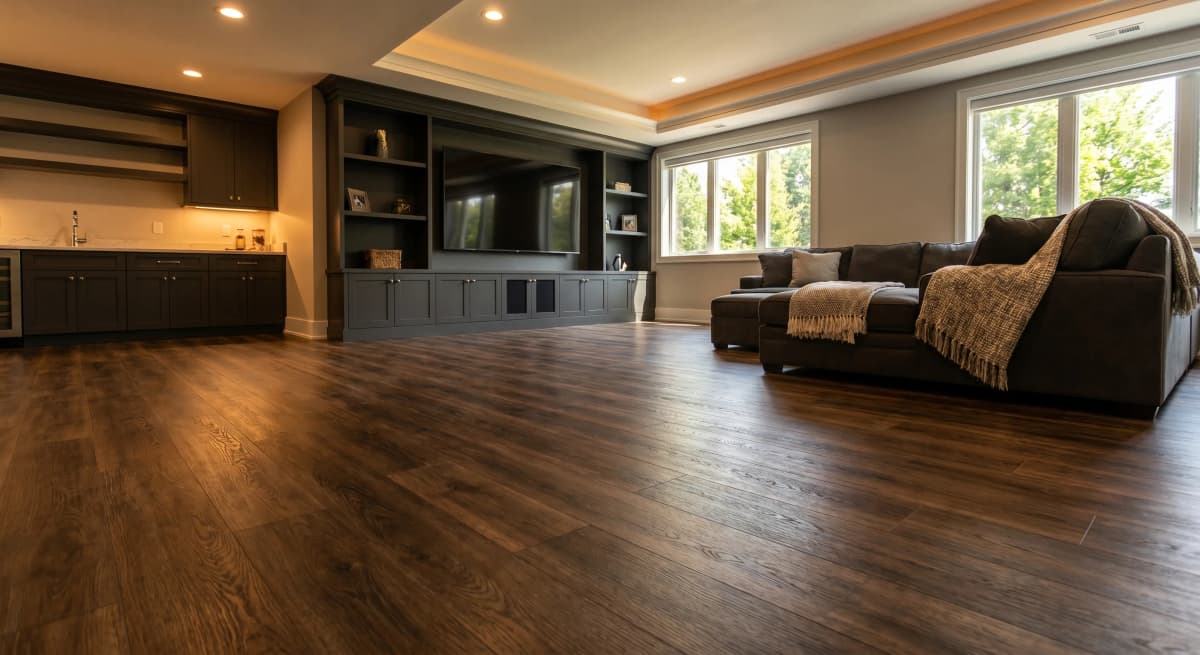
For basement apartments in Ontario, 100% waterproof luxury vinyl plank (LVP) is the single best flooring choice — full stop. Concrete slabs in GTA homes emit moisture year-round, basement suites are legally required to meet Ontario Building Code habitability standards, and tenants will hold landlords accountable for flooring failures. Carpet traps allergens and holds moisture. Solid hardwood will cup and crack within one heating season. Laminate gives you 72 hours before the core swells permanently. Vinyl gives you none of those problems, at $2.19–$4.50/sqft installed, and it handles everything a basement throws at it.

Why Basements in Ontario Are a Flooring Nightmare (And What That Means for You)
Ontario basements — especially in homes built between 1980 and 2010 across Markham, Scarborough, Brampton, and Mississauga — share a set of characteristics that destroy the wrong flooring within 2–3 years:
- Concrete slab moisture: Even a "dry" concrete slab in a GTA home emits 3–5 lbs of moisture per 1,000 sqft per day. In spring thaw (March–May), that number spikes. Any flooring that absorbs moisture — solid hardwood, standard laminate, old-school carpet — will fail.
- Below-grade humidity swings: Toronto's humidity ranges from 20% RH in January (forced-air heating) to 80%+ RH in July. Materials that expand and contract with humidity, like solid hardwood, develop gaps in winter and buckle in summer.
- Cold subfloors: Basement slabs stay 12–16°C even in summer. Without proper underlayment, that cold transfers through the floor, making the space uncomfortable and increasing condensation risk at the floor surface.
- Occasional flooding: Whether it's a sump pump failure, a backed-up floor drain, or a tenant-caused overflow, basement floors get wet. Your flooring needs to survive that event, not be destroyed by it.
Understanding these realities is why the flooring choice for a basement apartment isn't just aesthetic — it's structural and legal. Ontario's Residential Tenancies Act requires landlords to maintain rental units in a good state of repair. Flooring that fails within 18 months is a liability, not just an inconvenience.
Flooring Options for Basement Apartments: The Honest Comparison
Here's how the main flooring categories stack up specifically for Ontario basement apartment conditions. This isn't a generic comparison — every rating below reflects below-grade, concrete-slab, GTA-climate reality.
| Material | Cost (Material Only) | Waterproof? | Moisture Resistance | Durability (Rental) | Basement Verdict |
|---|---|---|---|---|---|
| LVP / SPC Vinyl | $2.19–$4.50/sqft | ✅ 100% waterproof | Excellent — handles flooding | Excellent — 20–25 yr wear layer | ✅ Best choice |
| Waterproof Laminate | $1.49–$3.50/sqft | ⚠️ 72-hr protection only | Good — not for chronic moisture | Good — scratch resistant | ⚠️ Acceptable with conditions |
| Standard Laminate | $0.99–$2.50/sqft | ❌ Water-resistant only | Poor — swells in 24–48 hrs | Moderate | ❌ Not recommended |
| Engineered Hardwood | $4.00–$9.00/sqft | ❌ Never waterproof | Moderate — humidity sensitive | Good — refinishable | ⚠️ Risky without vapor barrier |
| Solid Hardwood | $5.00–$12.00/sqft | ❌ Never waterproof | Very poor — will cup/buckle | Good above grade only | ❌ Do not use in basements |
| Carpet | $1.00–$3.50/sqft | ❌ Absorbs moisture | Very poor — mold risk | Poor in rentals | ❌ Avoid in basement rentals |
| Ceramic / Porcelain Tile | $2.00–$6.00/sqft | ✅ 100% waterproof | Excellent | Excellent — but cold underfoot | ✅ Good but expensive to install |
The Case for Vinyl in a Basement Apartment (With Real Product Numbers)
Luxury vinyl plank dominates basement apartment installations in the GTA for one reason that overrides every other consideration: it is 100% waterproof, permanently, at every layer. The wear layer, the core, the backing — none of it absorbs water. You can mop it, flood it, and leave standing water on it for days without structural damage to the plank itself.
For landlords running a tight renovation budget, the Austin Brown by Falcon Flooring at $2.19/sqft is the most cost-effective professionally graded vinyl we carry. At 6mm thick with a rigid core, it handles minor subfloor imperfections (which are common on older concrete slabs) without telegraphing every crack and divot through the surface. The warm brown tone reads as hardwood from a distance — exactly what rental tenants expect — without any of hardwood's moisture vulnerabilities.
For a typical 800 sqft basement apartment in Markham or North York, material costs for the Austin Brown come to roughly $1,752. Add professional installation at $1.50–$2.50/sqft and you're looking at a complete floor for $3,000–$3,750 all-in. That's a durable, tenant-ready floor that will last 15–20 years with normal use.
Browse our full waterproof flooring collection if you want to compare more options at different price points before committing.
When Laminate Works in a Basement (And When It Doesn't)
Laminate flooring is the most misunderstood product in basement renovations. Contractors and homeowners often reach for it because it's cheaper than vinyl and looks great in the showroom. Here's the honest breakdown:
Modern waterproof laminate — products with sealed edges and hydrophobic cores — provides 72-hour waterproof protection. That means if a glass of water sits on the floor overnight, you're fine. If a tenant's dishwasher leaks while they're on vacation for a week, you're replacing the floor. That's the real-world limitation.
For basements with excellent drainage, no history of water intrusion, and a properly installed vapor barrier over the concrete, quality laminate is a viable option. The Tosca Laminate 9911 by Tosca Floors at $1.49/sqft is one of the most affordable entry points we carry — ideal for landlords doing a budget renovation on a basement unit where moisture risk is low and controlled.
If you want the look and feel of laminate but with more peace of mind, the Sunshine Infiniti 12mm Laminate by NAF Flooring at $2.39/sqft is a 12mm product with a more substantial feel underfoot — the extra thickness helps with the cold-floor sensation common in basements, and the AC4 wear rating handles heavy foot traffic. Still, it carries the same 72-hour waterproof limitation as all laminate products. Do not install it in a basement with any active moisture issues.
The rule of thumb: If you've ever had water in that basement — even once — install vinyl, not laminate.
Ontario Building Code: What Landlords Must Know Before Installing Flooring
Ontario's Building Code (OBC) and the Ontario Fire Code have specific requirements for basement apartments (also called secondary suites or accessory dwelling units). Flooring choices intersect with these rules in several ways:
- Minimum ceiling height: 1.95m (6'5") is required in habitable rooms. If you're installing a floating floor system with thick underlayment, account for the height reduction — especially near doorways and under low beams.
- Vapor barrier requirement: The OBC requires a vapor barrier between a concrete slab and any wood-based flooring product. This includes laminate, engineered hardwood, and hardwood. Vinyl over concrete does not technically require a vapor barrier, but a moisture-blocking underlayment is still strongly recommended in GTA basements.
- Egress windows and floor transitions: If your renovation includes widening egress windows (required for basement bedrooms), the floor transition at that wall needs to be planned before flooring is installed.
- Fire separation: The OBC requires a fire separation between a basement apartment and the rest of the house. This affects how flooring meets walls and how gaps are sealed — a detail that matters during city inspections.
- Permit requirements: Creating a new basement apartment in Ontario requires a building permit in most municipalities. Flooring replacement in an existing legal suite typically does not, but verify with your local building department (Toronto, Markham, Mississauga, etc.) before starting work.
If you're unsure about the scope of your project, our free in-home measurement service includes a site assessment where we can flag any subfloor or moisture issues before you commit to a product.
GTA-Specific Realities: What Makes Basement Flooring Different Here
National flooring guides won't tell you this, but basement flooring in the Greater Toronto Area has specific challenges that don't apply in Vancouver, Calgary, or anywhere south of the border:
Freeze-thaw cycles and hydrostatic pressure: Toronto averages 30+ freeze-thaw cycles per winter. Each cycle pushes groundwater against basement walls and slabs. Homes in Scarborough, Pickering, and Ajax — built on clay-heavy soil — are especially prone to hydrostatic pressure pushing moisture through the slab from below. A standard vapor barrier won't stop this. If you see white powdery deposits (efflorescence) on your concrete slab, that's mineral-laden water coming through — address the moisture source before installing any flooring.
Builder-grade subfloors aging out: Homes built in the 1990s and 2000s across Markham, Richmond Hill, and Vaughan often have OSB subfloors over the basement slab as part of a finished basement. That OSB is now 20–30 years old. Before installing new flooring, check for soft spots, delamination, and mold. Replacing rotted OSB adds $1.50–$3.00/sqft to your project cost but is non-negotiable.
Radiant heat compatibility: Some newer GTA homes have in-floor radiant heat in the basement. If yours does, your flooring choice is constrained. LVP vinyl is compatible with radiant heat up to 27°C surface temperature. Most laminate products are also compatible but check the manufacturer spec sheet. Solid hardwood and thick engineered hardwood are generally not recommended over radiant heat.
For a full breakdown of what flooring costs look like in the GTA right now, see our 2026 Flooring Cost Guide for Toronto. And if you're not sure what product grade makes sense for a rental unit versus an owner-occupied space, our flooring grade guide explains AC ratings and wear layer thickness in plain language.
Practical Installation Tips for Basement Apartments
Even the right product will fail if it's installed incorrectly in a basement. Here's what separates a 20-year floor from a 3-year floor:
- Test for moisture before anything else. Tape a 18"×18" piece of plastic sheeting to the bare concrete slab. Seal all four edges with tape. Wait 72 hours. If there's condensation on the underside of the plastic, you have active slab moisture. Address it with a penetrating concrete sealer before installing any flooring product.
- Acclimate your materials. Bring flooring boxes into the basement space 48–72 hours before installation. Basement temperatures and humidity differ from the rest of the house. Acclimation prevents post-install expansion or contraction.
- Use the right underlayment. For vinyl over concrete, use a 2mm–3mm foam underlayment with a built-in vapor barrier. For laminate over concrete, use a 6-mil poly vapor barrier plus a separate underlayment, or a combo product. Never skip the vapor barrier on concrete.
- Leave expansion gaps. Floating floors need 1/4" expansion gap at all walls and vertical obstructions. In basements, where humidity swings are more extreme, skipping this gap causes buckling. Cover gaps with appropriate baseboards or quarter-round.
- Plan your transitions. Basement apartments often have transitions between the main living area, bathroom (tile), and utility areas. Plan these transitions before cutting your first plank. Our stair nosing and transition options can help if your basement has a staircase landing.
- Remove old carpet properly. If you're replacing carpet in a basement apartment, old carpet often traps years of moisture, pet dander, and mold spores against the concrete. Our carpet removal service includes proper disposal — don't just roll it up and leave it in the backyard.
Budget Planning: What a Basement Apartment Floor Actually Costs in 2026
Here's a realistic cost breakdown for a 700–1,000 sqft basement apartment in the GTA, using products from our current inventory:
- Budget vinyl option (Austin Brown, Falcon Flooring): $2.19/sqft material + $1.75/sqft installation + $0.30/sqft underlayment = ~$4.24/sqft all-in. For 800 sqft: approximately $3,392.
- Budget laminate option (Tosca 9911): $1.49/sqft material + $1.75/sqft installation + $0.40/sqft underlayment/vapor barrier = ~$3.64/sqft all-in. For 800 sqft: approximately $2,912. (Only viable where moisture is confirmed low.)
- Mid-range laminate (NAF Sunshine Infiniti 12mm): $2.39/sqft material + $1.75/sqft installation + $0.40/sqft underlayment = ~$4.54/sqft all-in. For 800 sqft: approximately $3,632.
- Subfloor prep (if needed): Grinding high spots on concrete: $0.50–$1.00/sqft. Patching cracks: $150–$300 flat. Replacing damaged OSB: $2.00–$3.50/sqft.
Use our quote calculator to get a project-specific estimate based on your square footage and chosen product. Or check our clearance section for discounted stock that works well in rental units where budget is the primary constraint.
Your next step
If vinyl plank is the right call for your space, the next move is to see it in person. Browse in-stock vinyl plank flooring with live pricing, then book a free in-home measurement: we confirm square footage, check the subfloor and quote the floor and install ($2.00 per sqft for floating installs) as one firm number. Questions first? Call (647) 428-1111 or visit our Markham showroom (Mon to Sat, 10am to 5pm).
Frequently Asked Questions
Is vinyl flooring required for basement apartments in Ontario, or can I use laminate?
Ontario Building Code doesn't specify a flooring material — but it does require landlords to maintain units in a good state of repair. Laminate with 72-hour waterproof protection is technically allowed, but in any basement with a history of moisture, flooding, or high humidity, vinyl is the only material that won't need replacement within a few years. If your basement is genuinely dry and you've tested the slab for moisture, waterproof laminate like the NAF Sunshine Infiniti 12mm is a legitimate option. If there's any doubt, use vinyl.
Can I install engineered hardwood in a basement apartment?
You can, but it carries real risk. Engineered hardwood is more dimensionally stable than solid hardwood, but it is not waterproof and is not immune to humidity-related movement. In a GTA basement with concrete slab moisture and seasonal humidity swings, engineered hardwood will show movement — gaps in winter, slight cupping in summer — within 2–3 years. For a rental unit where you need durability and low maintenance, it's not the right call. For an owner-occupied finished basement where aesthetics matter more and you're willing to manage humidity carefully, it can work with a proper vapor barrier and a dehumidifier.
What's the minimum flooring thickness for a basement apartment in Ontario?
There's no OBC-mandated minimum thickness for flooring itself, but thickness matters practically. In basements, minor concrete slab irregularities (up to 3/16" over 10 feet) are common. A 6mm vinyl plank like the Austin Brown by Falcon handles those imperfections better than a 4mm product. For laminate, 8mm is the practical minimum for basement use; 12mm (like the NAF Sunshine Infiniti) provides noticeably better rigidity and insulation from the cold slab.
How do I deal with a cold basement floor for my tenant?
Cold floors are one of the top tenant complaints in Ontario basement apartments. The concrete slab stays cold year-round, and that cold transfers through thin flooring. The most effective solutions: (1) Use a thicker flooring product — 10mm–12mm laminate or 6mm+ SPC vinyl provides meaningfully better thermal resistance than 4mm products. (2) Use an underlayment with thermal insulation properties (look for underlayment with an R-value rating). (3) If budget allows, a cork underlayment provides the best warmth and sound absorption. (4) In extreme cases, a floating subfloor system (DRIcore panels) creates an air gap between the concrete and the flooring, which dramatically reduces cold transfer.
Do I need a permit to replace flooring in an existing basement apartment in Ontario?
Replacing flooring in an existing, legally permitted basement apartment is generally considered maintenance and does not require a building permit in most Ontario municipalities, including Toronto, Markham, and Mississauga. However, if your basement apartment is not yet permitted (i.e., you're converting an unfinished basement or legalizing an existing suite), a building permit is required for the overall project, and the city inspector will check all aspects of the unit including flooring transitions and fire separations. Always verify with your local building department before starting any renovation on a rental unit.
What's the most durable flooring for a basement apartment with high tenant turnover?
For high-turnover rentals, prioritize scratch resistance and ease of spot repair. SPC (stone plastic composite) vinyl with a 12-mil or higher wear layer is the most durable option — it resists furniture scuffs, pet nails, and dropped objects better than laminate. The Austin Brown by Falcon Flooring at $2.19/sqft is a practical choice here: the rigid core doesn't dent under furniture legs, and individual planks can be replaced if a section is damaged without redoing the whole floor. Avoid carpet entirely in high-turnover units — cleaning costs between tenants routinely exceed the original carpet installation cost.
Ready to floor your basement apartment the right way? BBS Flooring serves landlords and homeowners across the GTA from our Markham showroom at 6061 Highway 7. We stock the products referenced in this guide and can walk you through the right choice for your specific basement conditions.
📞 Call (647) 428-1111 to speak with a flooring specialist.
📐 Book a free in-home measurement — we'll assess your subfloor, measure your space, and give you a written quote before you commit to anything.