Hardwood vs Engineered Hardwood: The Honest Comparison (2026)
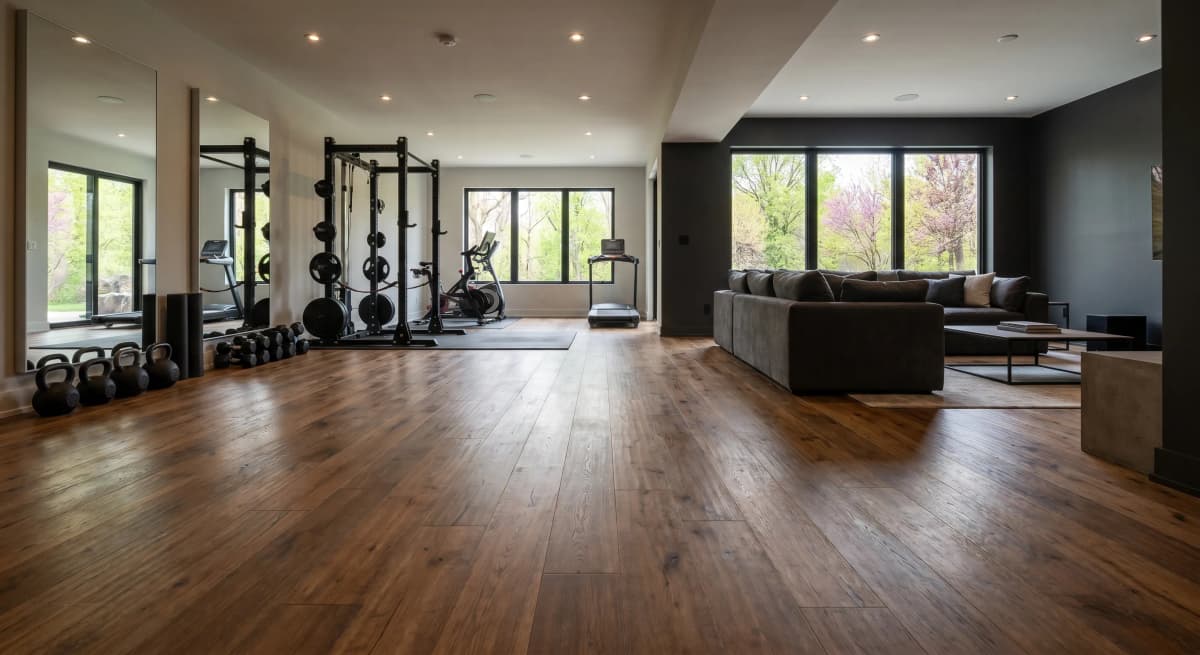
Solid hardwood and engineered hardwood are both real wood floors — but they behave very differently once they're installed in a GTA home. The short answer: solid hardwood gives you more refinishing cycles and deeper character over decades, but engineered hardwood handles moisture, concrete subfloors, and Canada's freeze-thaw humidity swings far better. For most Toronto-area homes built after the 1990s — especially those with open-concept main floors over concrete or grade-level subfloors — engineered hardwood is the more practical choice. Solid hardwood earns its place in above-grade rooms with plywood subfloors and a homeowner who plans to stay 20+ years.
What's Actually Inside Each Product
Solid hardwood is exactly what it sounds like: a single piece of milled wood, typically ¾" thick, from top to bottom. Red oak, white oak, maple, and hickory are the most common species in Canadian homes. Because the entire board is one material, it can be sanded and refinished multiple times — usually 5–7 times over its life — which is why a well-maintained solid floor in a 1960s Toronto home still looks good today.
Engineered hardwood is a layered product: a real hardwood veneer on top (typically 2mm–6mm thick) bonded to a cross-ply core of plywood or HDF. The cross-ply construction is what makes it dimensionally stable — the layers pull against each other when humidity changes, so the board doesn't cup, gap, or buckle the way solid wood can. The top veneer is still genuine hardwood, so it looks and feels identical to solid underfoot. The difference is in how many times you can sand it: a 3mm veneer gets you 1–2 refinishes; a 6mm veneer gets you 3–4.
Neither product is waterproof. Engineered hardwood is more moisture-tolerant than solid, but standing water will damage both. If your concern is a wet basement, bathroom, or mudroom, 100% waterproof flooring options like SPC vinyl are the right category entirely.
Side-by-Side Comparison
| Factor | Solid Hardwood | Engineered Hardwood |
|---|---|---|
| Material cost (GTA) | $6–$14/sqft | $3.89–$8/sqft |
| Installation cost (GTA) | $3–$5/sqft (nail-down only) | $2.50–$4.50/sqft (float, glue, or nail) |
| Total installed (1,500 sqft) | $13,500–$28,500 | $9,585–$18,750 |
| Refinishing cycles | 5–7 times | 1–4 times (veneer-dependent) |
| Suitable over concrete? | No — will cup and buckle | Yes (with moisture barrier) |
| Basement installation? | Not recommended | Above-grade only (not below-grade) |
| Radiant heat compatible? | Limited — species-dependent | Yes — most engineered products |
| Moisture tolerance | Low | Moderate (not waterproof) |
| Plank width options | 2¼"–5" (wider = more movement) | 3"–9" (wide planks are stable) |
| Resale impact (GTA) | Strong positive signal | Strong positive signal |
Refinishing: Where Solid Hardwood Still Wins
If longevity is your primary criterion, solid hardwood has a structural advantage that no engineered product can match: you can sand it back to bare wood and refinish it repeatedly. A ¾" solid oak floor installed in 1985 can still be sanded today. That's 40 years and potentially 5–6 refinishes. Each refinish costs roughly $2–$4/sqft in the GTA, which is far cheaper than replacement.
Engineered hardwood's refinishing potential depends entirely on veneer thickness. A 2mm veneer — common in budget products — can be lightly screened once, maybe twice, before you're into the core. A premium 6mm veneer gives you genuine refinishing flexibility. When you're shopping engineered hardwood, always ask for the veneer thickness in millimetres, not just the total board thickness.
For most GTA homeowners who renovate every 15–20 years anyway, the refinishing advantage of solid hardwood is less decisive than it sounds. A quality engineered floor with a 4mm+ veneer will outlast two renovation cycles without refinishing if maintained properly.
The GTA Subfloor Reality: Why This Decision Is Often Made for You
Here's the local context that national flooring guides never cover: a significant portion of GTA homes built between 1985 and 2010 have concrete subfloors on the main level, particularly in townhomes, semi-detached builds, and ground-floor condos. Solid hardwood cannot be installed over concrete — full stop. The moisture vapor that migrates through concrete year-round will cause solid boards to cup, crown, and eventually buckle, regardless of how many moisture barriers you lay down.
Engineered hardwood, because of its cross-ply core, handles the vapor transmission that concrete subfloors produce. It still requires a proper moisture test (we use a calcium chloride test before any installation) and a 6-mil poly barrier minimum, but it performs reliably in these conditions.
Even in homes with plywood subfloors — typical in pre-1990 detached houses in Markham, Richmond Hill, and Scarborough — the subfloor condition matters. If the plywood is less than ¾" thick or has significant flex, solid hardwood will squeak. Engineered hardwood's floating or glue-down installation methods are more forgiving of minor subfloor imperfections.
GTA's climate adds another variable: indoor relative humidity swings from roughly 20–25% in January (forced-air heating dries everything out) to 60–70% in August. Solid hardwood moves with these cycles — gaps in winter, slight crowning in summer — which is normal but visible in wide-plank formats. Engineered hardwood moves significantly less, which is why wide-plank formats (7" and above) are almost always engineered. See our flooring grade guide for how species and cut affect this movement.
Cost Breakdown for a Typical GTA Home
Let's use a realistic scenario: a 1,400 sqft main floor in a 2003-built Markham semi-detached, replacing builder-grade strip hardwood that's showing wear. Add 10% waste factor, so you're buying material for roughly 1,540 sqft.
- Budget engineered hardwood (e.g., Silk by Falcon Flooring — 6½" Red Oak Engineered Hardwood at $3.89/sqft): Material ~$5,990 + installation ~$3,500–$4,500 = $9,490–$10,490 total
- Mid-range engineered hardwood (e.g., Chelsea by Woden — Grand Chateau Oak 7½" Engineered Hardwood at $4.29/sqft): Material ~$6,607 + installation ~$3,500–$4,500 = $10,107–$11,107 total
- Premium engineered hardwood (e.g., Natural by NAF — 6½" Maple Engineered Hardwood at $4.99/sqft): Material ~$7,685 + installation ~$3,500–$4,500 = $11,185–$12,185 total
- Entry solid hardwood (Red Oak, unfinished): Material ~$9,240–$10,780 + installation ~$4,620–$6,160 + finishing ~$2,800–$4,200 = $16,660–$21,140 total
These numbers include carpet or old flooring removal if needed (typically $0.75–$1.25/sqft additional). Use our quote calculator to get a project-specific number, or see the full GTA flooring cost guide for 2026.
Resale Value: Does the Distinction Matter to Buyers?
In the GTA real estate market, both solid and engineered hardwood are marketed as "hardwood floors" — and buyers respond to both positively. Real estate agents in Markham, North York, and Mississauga generally don't distinguish between the two in listings. What buyers notice is condition, colour, and plank width — not the construction method beneath the finish layer.
That said, a knowledgeable buyer or home inspector will identify solid hardwood by its thickness and nail pattern. Some buyers in the $1.5M+ detached home segment do specifically look for solid hardwood as a quality signal. For the majority of GTA resale transactions, a well-installed engineered hardwood floor in a current format (wide plank, matte finish, natural tones) will perform as well or better than dated solid hardwood in a 2¼" strip format.
The resale calculus is simple: a floor that looks current and is in good condition adds value; a floor that looks dated or worn subtracts it, regardless of material.
Installation Methods and What They Mean for Your Project
Solid hardwood has one installation method: nail-down (or occasionally staple-down) over plywood. This requires a minimum ¾" plywood subfloor and a pneumatic flooring nailer. It cannot float, and it cannot be glued to concrete.
Engineered hardwood supports three methods:
- Floating: Boards click or glue together at the edges and float over an underlayment. Fastest installation, easiest DIY, but can sound slightly hollow underfoot. Works over concrete or plywood.
- Glue-down: Full-spread adhesive directly to concrete or plywood. Most stable result, eliminates hollow sound, but permanent. Required for most radiant heat applications.
- Nail-down: Same as solid hardwood, over plywood only. Common when matching existing solid hardwood in the same home.
Our installation team assesses your specific subfloor before recommending a method — the wrong choice for your subfloor type is one of the most common causes of floor failure. If your project includes stair nosing or stair capping, engineered hardwood has more compatible pre-made stair products available than solid, which often requires custom routing.
Which One Should You Actually Buy?
Run through this decision tree:
- Concrete subfloor on main level? → Engineered hardwood only.
- Basement installation? → Neither. Consider luxury vinyl plank or laminate for below-grade spaces.
- Radiant in-floor heat? → Engineered hardwood (glue-down method).
- Wide planks (7"+) on a budget? → Engineered hardwood — the stability makes wide formats viable.
- Plywood subfloor, above grade, 20+ year horizon, willing to refinish? → Solid hardwood is a defensible choice.
- Matching existing solid hardwood in an older home? → Solid hardwood if the subfloor supports it; engineered hardwood with a matching species/stain if not.
Browse our full engineered hardwood collection or solid hardwood options to compare what's currently in stock. If you're specifically interested in white oak — the most-requested species in the GTA right now — see our white oak flooring page for both solid and engineered formats.
Your next step
If engineered hardwood is where you are landing, see the boards in person before you decide. Browse in-stock engineered hardwood with live pricing, then book a free in-home measurement. We confirm square footage, check the subfloor and quote the floor and installation as one firm number. Call (647) 428-1111 or visit our Markham showroom (Mon to Sat, 10am to 5pm).
Frequently Asked Questions
Is engineered hardwood as good as solid hardwood?
For most GTA homes, engineered hardwood is the more practical choice — it installs over concrete subfloors, handles humidity swings better, and costs less. Solid hardwood has one clear advantage: more refinishing cycles (5–7 vs. 1–4), which matters if you plan to keep the floor for 30+ years and refinish it multiple times. Both are genuine hardwood products and both add real value to a home.
Can engineered hardwood be refinished?
Yes, but the number of times depends on veneer thickness. A 2mm veneer can typically be lightly screened once. A 4–6mm veneer can be sanded and refinished 2–4 times. Always confirm veneer thickness in millimetres before purchasing — total board thickness (e.g., 12mm or 15mm) tells you very little about refinishing potential.
How long does engineered hardwood last?
A quality engineered hardwood floor with a 3mm+ veneer, properly installed and maintained, will last 25–40 years before replacement is necessary. Budget products with thin veneers and HDF cores have a realistic lifespan of 15–20 years. The finish warranty (typically 25–50 years on premium products) is a useful proxy for quality.
Can you install hardwood over concrete in a Toronto home?
Solid hardwood cannot be installed over concrete — moisture vapor from the slab will cause cupping and buckling over time, regardless of moisture barriers. Engineered hardwood can be installed over concrete using a glue-down or floating method, provided a moisture test is done first and the slab reads within acceptable limits (typically under 3 lbs per 1,000 sqft per 24 hours on a calcium chloride test).
Does engineered hardwood add resale value in the GTA?
Yes. GTA buyers and real estate agents treat engineered hardwood as equivalent to solid hardwood in listings. What affects resale value more than the construction method is the condition, colour, and format of the floor — a current wide-plank engineered floor in good condition will outperform dated narrow-strip solid hardwood in most resale scenarios.
What's the cheapest way to get a real hardwood look in a GTA home?
Entry-level engineered hardwood starts around $3.89/sqft — the Silk by Falcon Flooring 6½" Red Oak is a strong option at that price point. If budget is the primary constraint, check our clearance section for discontinued runs of engineered hardwood, which can come in significantly under retail. Laminate and LVP are cheaper still but are not real wood products.
Ready to choose the right floor for your home?
Book a free in-home measurement and we'll assess your subfloor type, measure your space, and give you a firm quote — no guesswork. Call (647) 428-1111 or visit our showroom at 6061 Highway 7, Markham to see solid and engineered hardwood samples side by side.