How Much Flooring Do I Need? Calculator + Formula
To calculate how much flooring you need, multiply the room's length by its width in feet to get square footage, then add a waste factor of 7–15% on top. For a standard rectangular 15 × 12 ft bedroom, that's 180 sqft + 10% = 198 sqft to order. That's the core math — but the waste factor varies by material and layout, and getting it wrong means a costly second order or leftover boxes collecting dust in your garage.
The Exact Formula: Step-by-Step
Here's the calculation broken into four steps you can do with a tape measure and a phone:
- Measure each room: Length × Width = Room Sqft. For irregular rooms, break them into rectangles and add the totals.
- Add all rooms together: Get a single total sqft number for the whole project.
- Add your waste factor: Multiply your total by 1.07 (7%), 1.10 (10%), or 1.15 (15%) depending on material and layout direction (see table below).
- Round up to the nearest full box: Most flooring is sold in boxes covering 20–25 sqft. Never round down.
Quick example: Open-concept main floor — living room (18 × 16 = 288 sqft) + dining room (12 × 10 = 120 sqft) + hallway (4 × 22 = 88 sqft) = 496 sqft total. Add 10% waste = 545.6 sqft. Order 546 sqft, divided by 22 sqft per box = 25 boxes (round up from 24.8).
Want to skip the math entirely? Use our interactive quote calculator — enter your room dimensions and it handles the waste factor automatically based on the material you select.
Waste Factor by Material and Layout
The single most common mistake DIYers make is applying a flat 10% to every project. The real waste factor depends on what you're installing and how you're running it:
| Material | Straight Layout | 45° Diagonal Layout | Why It Varies |
|---|---|---|---|
| Vinyl / LVP / SPC | 7–10% | 12–15% | Click-lock planks cut cleanly; diagonal creates more end waste |
| Laminate | 10% | 15% | Stagger requirements increase cut waste at row ends |
| Engineered Hardwood | 10% | 15% | Natural variation means more defect sorting; longer planks reduce waste |
| Solid Hardwood | 10–12% | 15–18% | Nail-down requires more cuts; character grades have higher cull rate |
| Ceramic / Porcelain Tile | 10% | 15–20% | Breakage during cutting; grout lines affect layout |
Pro note: If your room has multiple doorways, bay windows, or a fireplace hearth cutting into the floor space, add an extra 2–3% on top of the standard waste factor. Each inside corner is a cut, and cuts create offcuts.
How to Measure Irregular Rooms (L-Shapes, Alcoves, Open Concepts)
Most homes — especially GTA semis and detached houses built in the 1990s and 2000s — don't have perfectly rectangular rooms. Here's how to handle the most common shapes:
L-Shaped Rooms
Split the L into two rectangles. Measure each rectangle separately (Length × Width), add them together. Don't try to measure the overall bounding box — you'll massively overorder.
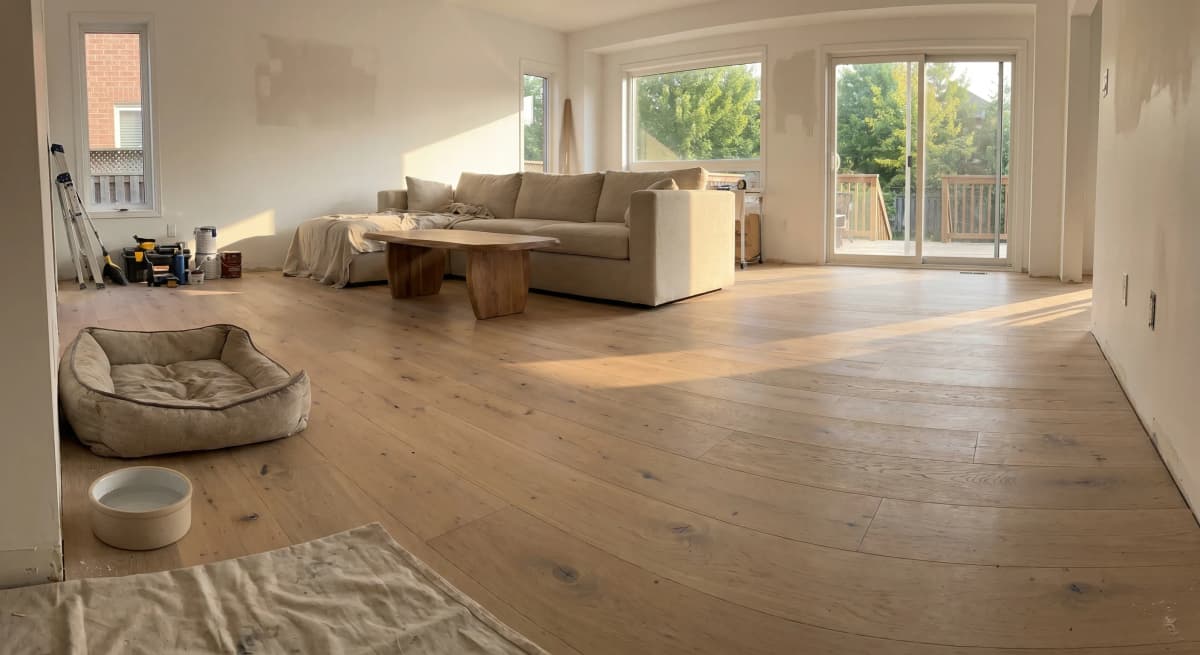
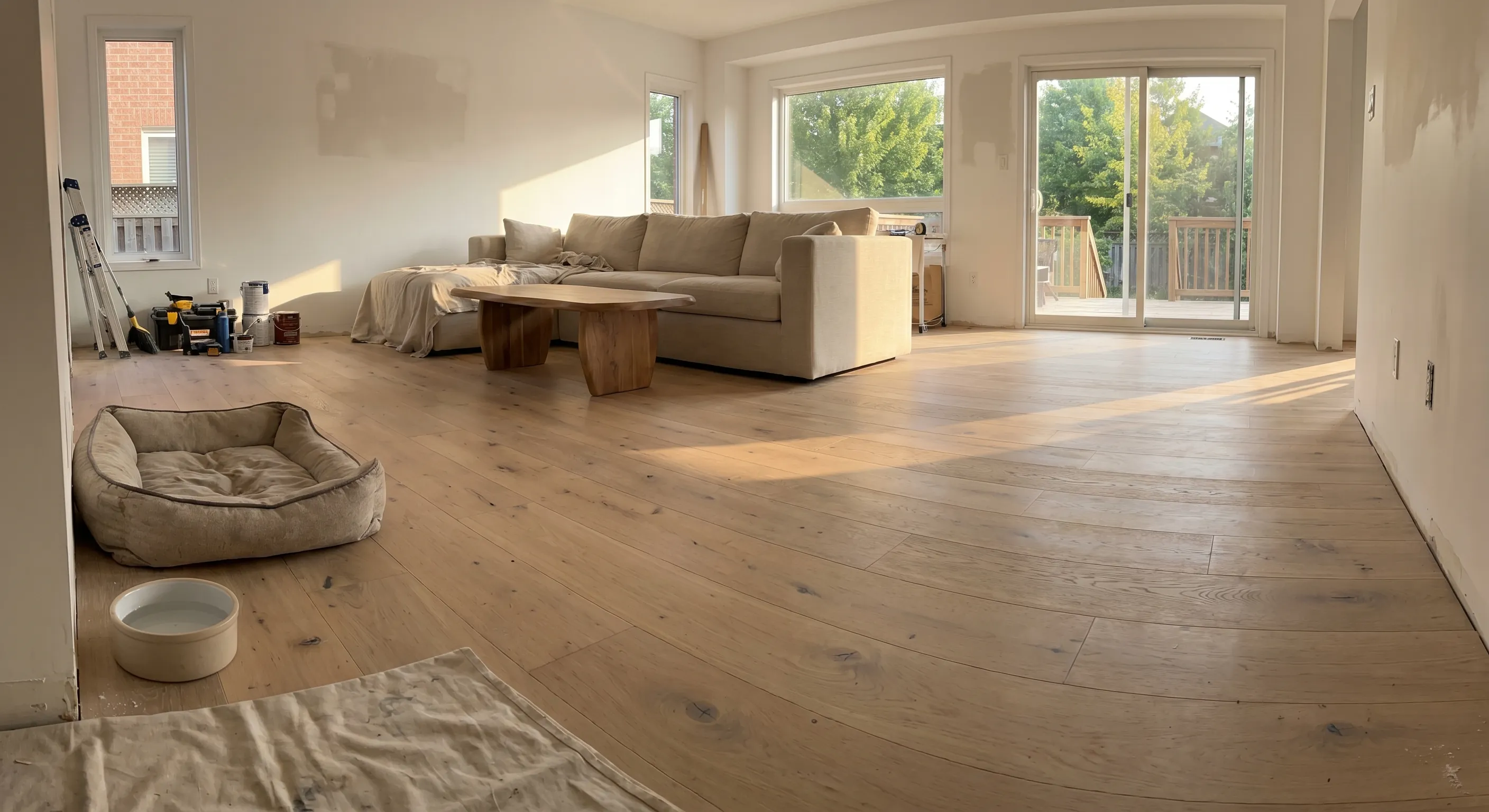
Open-Concept Main Floors
Measure the entire open area as one continuous space. Include the kitchen if it's getting the same flooring. Subtract any islands or permanent fixtures that sit directly on the floor (measure their footprint and subtract it — though most installers leave a small margin anyway).
Closets
Always include closet floor area. It's a common miss. A standard 2 × 5 ft closet is only 10 sqft, but across four bedrooms that's 40 sqft — nearly two boxes of flooring you didn't account for.
Hallways
Measure hallway width at the narrowest point × full length. In older GTA homes, hallway widths vary — don't assume a standard 3 ft width.
For complex floor plans, our team offers a free in-home measurement service in Markham and across the GTA. We measure every room, account for all transitions, and give you an exact material quantity — no guesswork.
Calculating Flooring for Stairs
Stairs are calculated differently from flat floors. Each stair has two surfaces: the tread (horizontal surface you step on) and the riser (vertical face). Standard stair dimensions in Canadian homes:
- Tread depth: 10–11 inches
- Riser height: 7–7.5 inches
- Stair width: 36–42 inches (most residential)
Formula per stair: (Tread depth + Riser height) × Stair width = sqft per stair. For a standard 10.5" tread + 7.5" riser on a 36" wide staircase: (10.5 + 7.5) ÷ 12 × 3 = 4.5 sqft per stair.
A typical GTA two-storey home has 13–15 stairs from main to second floor. At 4.5 sqft each, that's 58–67 sqft of stair material — plus a 15–20% waste factor for stair work, since every stair is a cut piece. Budget roughly 75–80 sqft of material for a standard 14-stair staircase.
Stairs also require nosing pieces (the bullnose trim that caps the front edge of each tread). Count your stairs and order matching nosing. Learn more on our stair flooring page.
GTA-Specific Sizing Reality: What Toronto Homes Actually Look Like
National flooring calculators use generic square footage assumptions that don't match GTA housing stock. Here's what real project sizes look like in the Greater Toronto Area:
- Markham / Stouffville detached (2000s–2010s build): Main floor 900–1,100 sqft, second floor 800–1,000 sqft, finished basement 700–900 sqft. Full-home project: 2,400–3,000 sqft.
- North York / Scarborough semi-detached (1980s–1990s): Main floor 550–750 sqft, second floor 550–700 sqft. Full-home (excluding basement): 1,100–1,450 sqft.
- Toronto condo (downtown core): 500–850 sqft total, one open-plan space. These projects are deceptively complex due to irregular layouts and multiple transition strips.
- Vaughan / Richmond Hill newer build: Main floor 1,200–1,500 sqft open concept, second floor 1,000–1,200 sqft. Full-home often 2,500–3,500 sqft including basement.
GTA basements deserve a special mention. Most homes built before 2005 have concrete slab subfloors in the basement — which means you need flooring that handles slab moisture. That rules out solid hardwood entirely and limits engineered hardwood options. 100% waterproof vinyl and SPC are the reliable choice for below-grade GTA applications. Our grade guide explains above-grade vs. on-grade vs. below-grade installation suitability for every material.
Material Cost Estimates: What Your Square Footage Actually Costs
Once you have your sqft number, here's what to budget for materials in the current GTA market (2026 pricing):
| Material | Material Cost ($/sqft) | Installation ($/sqft) | Waterproof? | Best Application |
|---|---|---|---|---|
| Vinyl / SPC / LVP | $2.00–$5.50 | $1.50–$2.50 | Yes — 100% | Basements, kitchens, full homes |
| Laminate | $1.80–$4.50 | $1.50–$2.25 | Water-resistant only | Bedrooms, living rooms, low-moisture areas |
| Engineered Hardwood | $4.00–$9.00 | $2.00–$3.50 | No | Main floors, above-grade bedrooms |
| Solid Hardwood | $6.00–$14.00 | $3.00–$5.00 | No | Above-grade only; main floors, bedrooms |
For a detailed breakdown of total installed costs by neighbourhood and home type, see our 2026 Toronto flooring cost guide.
Real product examples at current pricing:
- The 817 Simba Universe 6.5mm Vinyl by Simba Flooring ($2.59/sqft) is a 100% waterproof SPC option that works well for full-home projects where you want one material from basement to second floor. At that price, a 1,500 sqft project (with 10% waste = 1,650 sqft) runs $4,273.50 in materials.
- The Smoke 6" White Oak by Northernest Engineered Hardwood ($4.50/sqft) is a wide-plank white oak option suited to main-floor living areas. For a 900 sqft main floor with 10% waste (990 sqft), material cost is $4,455.
- The Coffee NAF 6½" Hickory Engineered Hardwood by NAF Flooring ($4.89/sqft) brings strong visual grain and hickory's natural hardness to above-grade applications. On a 750 sqft second floor (825 sqft with waste), that's $4,034.25 in materials.
If budget is a constraint, check our clearance inventory — discontinued runs and overstock at reduced prices, sold by the box while quantities last.
Don't Forget: What Else Gets Added to Your Material Order
Square footage of flooring is only part of the material list. A complete order also includes:
- Underlayment: Most vinyl and laminate needs a separate underlayment unless it's pre-attached. Budget 1 sqft of underlayment per sqft of flooring. Cost: $0.25–$0.65/sqft.
- Transition strips: Required wherever flooring meets a different surface — doorways, room boundaries, between flooring and tile. Count your doorways. Each transition is typically $15–$35 for the piece.
- Stair nosing: One piece per stair tread. See above.
- Baseboards and quarter-round: Measure your total linear footage of walls (perimeter of each room) if replacing trim. Typically 10–15% more than you think to account for cuts and corners.
- Carpet removal: If you're replacing carpet, factor in removal and disposal. Our carpet removal service handles this — pricing depends on sqft and accessibility.
Your next step
The fastest way to turn research into a firm number is to book a free in-home measurement: we confirm the square footage, check the subfloor and quote floor and installation together. Browse the full in-stock catalogue with live pricing, call (647) 428-1111, or visit our Markham showroom (Mon to Sat, 10am to 5pm).
Frequently Asked Questions
How much flooring do I need for a 12×12 room?
A 12 × 12 ft room is 144 sqft. Add a 10% waste factor and you need to order 158–160 sqft of flooring. Most boxes cover 20–25 sqft, so you'll need 7–8 boxes depending on box coverage. Always buy the extra box — running short mid-installation and needing to reorder the same lot number is a common and avoidable problem.
What waste factor should I use for vinyl plank flooring?
Use 7–10% for a straight installation and 12–15% for a diagonal (45°) layout. Vinyl plank cuts cleanly with a utility knife or score-and-snap, so waste is lower than tile or hardwood. For rooms with lots of doorways and alcoves, stay at 10% even for straight layouts.
Should I measure in feet or meters when calculating flooring?
Measure in feet for Canadian flooring purchases — virtually all flooring in Canada is priced and packaged in square feet. If your tape measure shows metric, convert: 1 metre = 3.281 feet. For a 4m × 3.5m room: 4 × 3.281 = 13.12 ft, 3.5 × 3.281 = 11.48 ft, 13.12 × 11.48 = 150.6 sqft.
Do I measure closets separately or include them with the room?
Include closet floor area in the same room measurement. Closets get the same flooring, and their square footage is easy to miss. A 2 × 4 ft reach-in closet adds 8 sqft; a 5 × 6 ft walk-in adds 30 sqft. Across a full home, missing all closets can mean you're 60–80 sqft short.
How do I calculate flooring for an open-concept main floor?
Treat the entire open area as one large rectangle (or break it into rectangles if it's L-shaped) and calculate total sqft. Don't measure room by room if the flooring runs continuously — you'll overcount transitions and undercount the continuous runs. Add 10% waste for the whole open area as a single number.
Can I use leftover flooring from one room in another room later?
Only if it's from the same production lot (same dye lot number). Flooring manufactured in different batches can vary slightly in colour, even within the same SKU. Always buy your full project quantity at once. If you have legitimate leftovers, keep 3–5% of your total order stored flat for future repairs — it's insurance against damage years down the road.
Get an exact number — not an estimate. Our team measures your home at no charge, gives you a room-by-room material quantity, and a complete installed price. Call (647) 428-1111 or book your free measurement online. Showroom at 6061 Highway 7, Markham — open 7 days a week.