DIY Stair Refinishing vs Professional: What Actually Pays Off
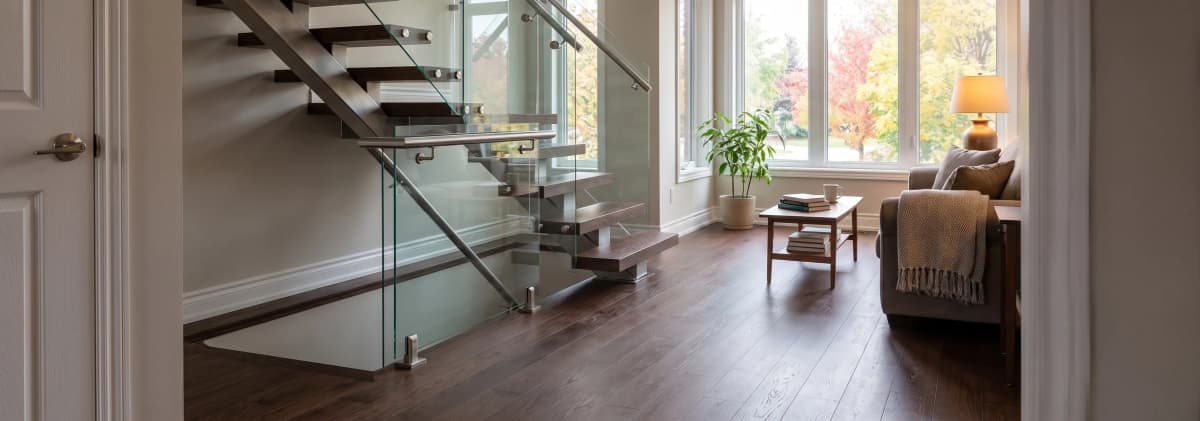
DIY stair refinishing makes sense if your treads are structurally sound, you have a full weekend free, and you're comfortable with a rented drum sander producing a LOT of fine dust throughout your house. Professional refinishing makes sense for everything else — damaged treads, gap filling, stain matching to an existing hardwood floor, or if your stairs are the only route between floors and you can't have them out of commission for 3-4 days. The real question isn't 'can I do this myself' (you can) — it's whether the $800-$1,400 you save on a typical 13-step Toronto staircase is worth the risk of uneven sanding, mismatched stain, and a set of stairs that looks worse than the builder-grade oak you started with.
What DIY Stair Refinishing Actually Involves (and Costs)
A DIY refinish on a standard 13-step staircase (the average in a 1990s-2010s GTA two-storey home) breaks down like this: drum or orbital sander rental ($60-$90/day, and you'll likely need it 2 days), sandpaper in multiple grits ($30-$50), wood filler for nail holes and gaps ($15-$25), stain ($40-$60/can), oil or water-based polyurethane ($50-$70/can, usually need 2-3 coats), plus tack cloths, brushes, painter's tape, and a respirator mask ($40-$60). That's roughly $250-$400 in materials alone — before you factor in your own labour, which for a first-timer runs 12-18 hours spread across a weekend, plus 24-48 hours of dry time between coats where the stairs are unusable.
The bigger cost is often invisible until it's too late: uneven sanding leaves swirl marks that only show up once stain is applied, corners and risers are hard to reach with a rental sander and get hand-sanded unevenly, and matching a new stain colour to an existing hardwood floor by eye rarely works on the first try. If your stairs connect to a room with our engineered hardwood already installed, a slightly-off stain match is the difference between a refresh and a flooring project you have to redo.
What Professional Stair Refinishing Includes
Professional refinishing starts from $125/step for standard treads and risers, confirmed after a site visit since every staircase has different wear, damage, and access. That price includes commercial-grade dustless sanding equipment (a genuine difference from a rented drum sander — far less airborne dust in your home), colour-matching to your existing hardwood using the same stain systems we use on full-floor installs, a sealed polyurethane finish rated for high-traffic stair use, and our 2-year workmanship warranty on the labour.
If your treads are cupped, split, or worn through to bare wood in the high-traffic centre (extremely common on stairs installed before 2010), sanding alone won't fix it — you need new hardwood treads, which start from $185/step for recapping or carpet-to-hardwood conversions. Curved stairs, landings, and open-riser designs are priced separately at $225/step because of the extra template and cut work involved, and any exposed trim pieces run $25/piece. All of this is confirmed on-site, not over the phone, because photos rarely show the full extent of subfloor and tread condition.
DIY vs Professional: The Honest Comparison
| Factor | DIY Refinishing | Professional (BBS Flooring) |
|---|---|---|
| Cost (13-step staircase) | $250-$400 materials + your time | From $1,625 (13 steps × $125), confirmed on-site |
| Time to complete | 2-4 days incl. dry time, stairs unusable | 1-2 days, dustless equipment |
| Dust in your home | Significant — travels through HVAC | Minimal — commercial dust containment |
| Stain colour matching | By eye, high risk of mismatch | Matched to existing hardwood on request |
| Damaged tread repair | Not possible with sanding alone | New treads from $185/step available |
| Warranty | None | 2-year workmanship warranty |
| Best for | Light cosmetic refresh, sound treads, DIYers with time | Worn/damaged treads, stain matching, safety concerns, tight timelines |
When DIY Actually Makes Sense
If your stairs are cosmetically dull but structurally fine — no cupping, no splits, no gaps wider than a dime — and you're refinishing to a similar or slightly darker shade (going lighter requires more aggressive sanding to remove old stain penetration), DIY can work. It's also reasonable if the staircase is in a secondary area, like a basement walk-up, where a few days of inconvenience doesn't disrupt daily life. Where DIY becomes risky is on a main staircase that's the only path to bedrooms, on stairs with any structural creaking (that's often a subfloor or stringer issue, not a finish issue), or when you're trying to match a specific hardwood species and stain already in your home.
The Hidden Cost Most DIYers Miss: Matching Your Existing Floor
A huge number of GTA homeowners refinish their stairs at the same time they replace or refresh their main floor hardwood — and this is where mismatched results happen most. If you're recapping worn treads rather than just refinishing, it's worth choosing a tread species and stain that ties directly into your flooring, not just whatever the rental store stain chart offers. The Gold Coast by Woden Flooring ($4.59/sqft) is a 6 1/2" white oak engineered hardwood that pairs well with the wider plank trend we're seeing in 2020s+ GTA renovations, and works as a tread-cap reference for stain matching. For homes with existing hickory character-grade floors, the Tavern by Northernest ($4.69/sqft) has the grain variation to hide minor wear on high-traffic tread noses far better than a flat, uniform oak. And for a classic red-oak-adjacent look common in 2000s-era GTA subdivisions, the Bermuda by NAF Flooring ($4.99/sqft) at 7 1/2" wide is a close visual match to the builder-grade oak still on staircases across Markham, Richmond Hill, and Vaughan. All three are available for viewing at our white oak flooring and engineered hardwood showroom sections.
GTA-Specific: Why Toronto Staircases Are Trickier Than a Weekend YouTube Tutorial
Most GTA homes built between 1995-2015 came with builder-grade solid red or white oak stair treads, finished on-site with a thin factory coat that's long gone by year 15-20. Two things make refinishing these stairs harder than a national how-to guide suggests. First, our winter heating season drops indoor humidity dramatically (often under 25% RH in a forced-air home), which shrinks solid wood treads and opens gaps at the riser joints — gaps a DIY sander won't see until stain highlights them. Second, many staircases in townhomes and semis built in this era sit directly against a shared party wall, meaning any structural noise (creaking, flex) is often a stringer or subfloor fastening issue that no amount of sanding or staining resolves — it needs to be addressed before finish work, or the new finish will crack at the same stress points within a year. If you're unsure whether your stairs need refinishing or replacement, our team assesses both during a free in-home measurement, and we can walk you through options using our 2026 Toronto flooring cost guide and grade guide to explain why some treads are salvageable and others aren't.
Cost Breakdown: Full Line-Item Comparison
- DIY refinish, sound treads: $250-$400 materials + 12-18 hours labour, stairs out of use 2-4 days
- Professional refinish: from $125/step ($1,625 for 13 steps), 1-2 days, dustless, warrantied
- New hardwood treads (recap/carpet-to-hardwood): from $185/step, needed when sanding won't fix damage
- Specialty steps (curved, landings, open-riser): $225/step
- Trim pieces: $25/piece
- Delivery of materials to site: free warehouse pickup, $140 garage drop, $200 inside-house delivery
For most 13-15 step GTA staircases, professional refinishing lands between $1,625-$2,200 depending on condition, while a full tread recap with new hardwood runs $2,400-$3,500+ before trim and specialty steps. Compare that to a full flooring installation quote using our quote calculator if you're bundling stairs with a full-floor refresh.
Frequently Asked Questions
Can I refinish stairs myself without sanding?
Only if the existing finish is intact and you're doing a screen-and-recoat (a light abrasion and new poly coat) rather than a full refinish. If the stain colour is worn through in the tread centre — which is common after 8-10 years — you need to sand down to bare wood, which a screen-and-recoat won't achieve.
How much does it cost to refinish stairs in Toronto vs DIY?
DIY materials run $250-$400 plus your own time for a 13-step staircase. Professional refinishing starts from $125/step, so $1,625 for the same 13 steps, confirmed after a site visit based on tread condition.
How long does DIY stair refinishing take?
Plan for a full weekend minimum: one day to sand and fill, then 2-3 additional days for stain and multiple polyurethane coats to cure between applications, during which the stairs should not be walked on.
Is stair refinishing worth it, or should I replace the treads?
If treads are cupped, cracked, or worn through with visible bare wood in high-traffic zones, refinishing alone won't hold — new hardwood treads (from $185/step) last longer and let you match your current floor finish exactly.
Do I need a permit to refinish or recap stairs in Ontario?
No permit is required for cosmetic refinishing or tread replacement that doesn't alter the stair structure, rise, run, or handrail configuration. Structural changes to stringers or stair dimensions may require a permit — check with your local municipality if you're altering more than the surface finish.
What's the safest way to refinish stairs with kids or pets in the house?
Professional dustless sanding equipment contains far more airborne dust than a rented drum sander, which matters most on stairs since they're a shared airflow path between floors. If you go DIY, seal off the stairwell with plastic sheeting and run air purifiers on adjacent floors during sanding.
If your staircase needs more than a weekend project — damaged treads, stain matching to existing hardwood, or you just don't have 3-4 days to lose access to your second floor — call us at (647) 428-1111 or visit our Markham showroom at 6061 Highway 7 to see tread samples in person. You can also book a free measurement and we'll give you a real number, not a range, before any work starts.