Stair Refinishing in Markham: Costs, Options & What to Expect
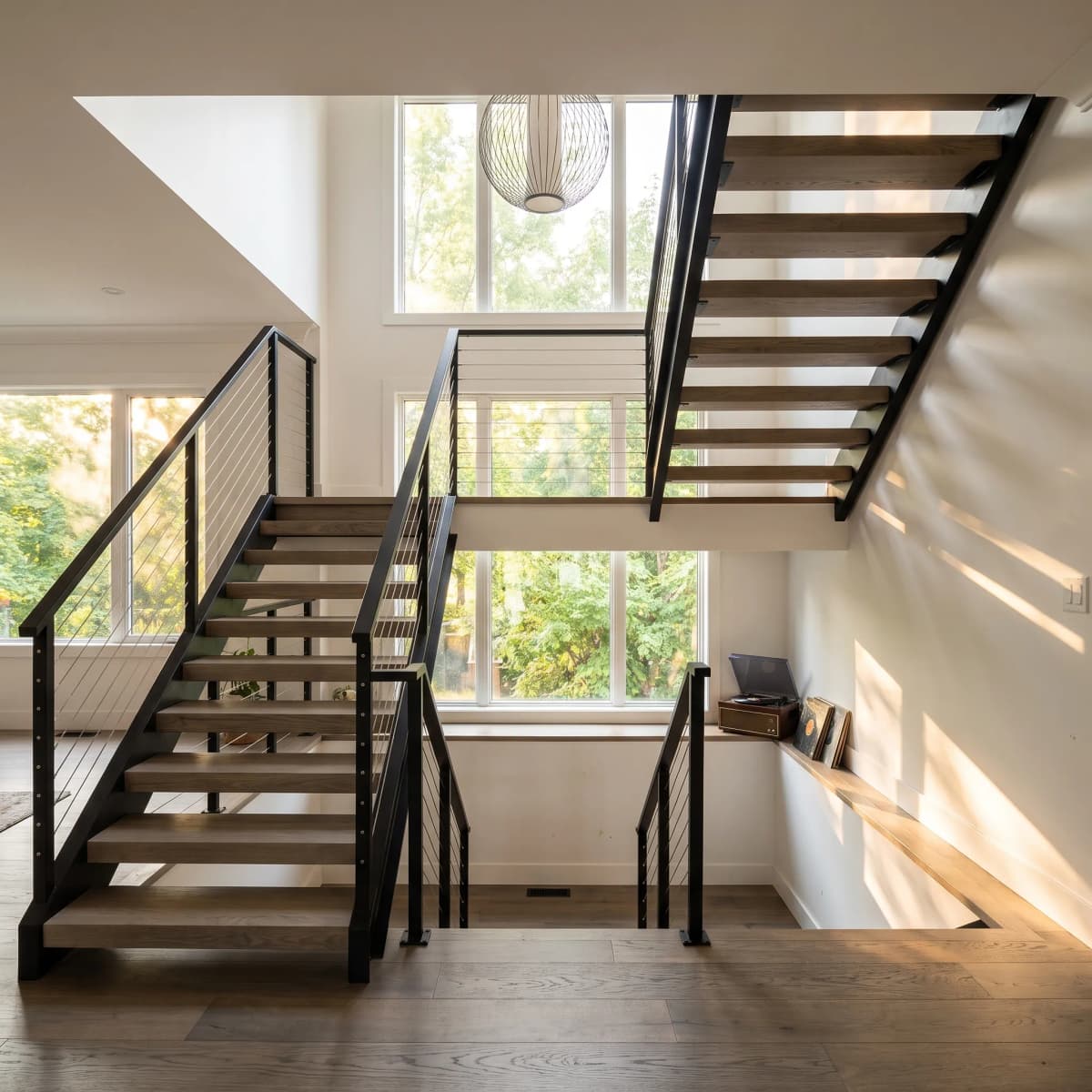
Stair refinishing in Markham typically costs $40–$90 per step for sanding and recoating existing hardwood, or $80–$180 per step if you're replacing treads with new engineered hardwood overlays. Which route makes sense depends on three things: what your stairs are currently made of, how much structural wear they've taken, and whether you want to change the look entirely or just restore what's there. Most Markham homes built between 1990 and 2010 have builder-grade oak stairs that are absolutely worth refinishing — the bones are solid, the wood is thick enough to sand again, and the result looks better than new carpet.
Sanding vs. Overlay: The Two Paths for Stair Refinishing
Before anything else, you need to decide whether you're sanding and recoating existing treads or installing new tread overlays on top of the existing structure. These are fundamentally different jobs with different costs, timelines, and results.
- Sanding and recoating: Works when your existing hardwood treads are at least ¾" thick and haven't been sanded more than 2–3 times before. The finish is stripped, the wood is sanded smooth, and 2–3 coats of polyurethane are applied. Typical timeline: 2–3 days including dry time. Cost: $40–$90 per step depending on tread width and condition.
- Tread overlays (capping): A new engineered hardwood tread is glued and nailed directly over the existing tread. This is the right call when stairs are carpeted, when the existing wood is too thin to sand again, or when you want a completely different species or colour. Cost: $80–$180 per step installed, depending on material. No sanding dust. Stairs are usable the same day in most cases.
- Full replacement: Entire stair structure is rebuilt. Rare, but necessary when treads are structurally compromised. Costs $200–$400+ per step and requires a carpenter, not just a flooring crew.
For most Markham homeowners, tread overlays with engineered hardwood are the most cost-effective path to a dramatic upgrade — especially if the stairs are currently carpeted. Our carpet removal service can strip the existing carpet before the overlay install, all in one visit.
What Stair Refinishing Actually Costs in Markham (2025–2026)
Here's a realistic breakdown of what you'll spend. A standard two-storey Markham home typically has 13–16 steps from main floor to second floor, plus potentially another 12–14 steps from main to basement.
| Method | Cost Per Step | 13-Step Staircase | Disruption | Best For |
|---|---|---|---|---|
| Sand & Recoat (water-based) | $40–$65 | $520–$845 | 2–3 days, dust + fumes | Solid hardwood treads in good shape |
| Sand & Recoat (oil-based) | $55–$90 | $715–$1,170 | 3–5 days, strong fumes | Deeper penetration, richer finish |
| Engineered Hardwood Overlay | $80–$150 | $1,040–$1,950 | 1–2 days, usable same day | Carpeted stairs, colour change, thin treads |
| Solid Hardwood Overlay | $110–$180 | $1,430–$2,340 | 1–2 days, usable same day | Matching existing solid hardwood floors |
| Full Tread Replacement | $200–$400+ | $2,600–$5,200+ | 3–5 days, structural work | Damaged or rotted treads |
These prices include labour and materials. Risers (the vertical face of each step) are typically an additional $15–$35 each if you want them done in matching hardwood or painted. Stringers (the side trim) add another $8–$20 per linear foot if they need refinishing or wrapping.
Want a number specific to your staircase? Use our quote calculator or book a free in-home measurement — we'll count every tread, check subfloor thickness, and give you a written quote on the spot.
The Best Engineered Hardwood Products for Stair Overlays
Not every flooring product works on stairs. You need minimum 3mm wear layer for durability under foot traffic, a species with a hardness rating above 1,000 on the Janka scale, and a finish that holds up to the repeated impact of heels and pet claws. Here are three products from our inventory that meet that standard:
The Ash Grey 6½" White Oak by Northernest ($4.99/sqft) is one of our most-requested stair materials right now. White oak sits at 1,360 on the Janka hardness scale — significantly harder than red oak — and the cool grey tone reads as modern without being trendy. The 6½" width means fewer seams on wider treads. If your main floor is white oak or you're planning to install white oak flooring throughout, this is the obvious match.
The Linen 6½" Red Oak by Falcon Flooring ($3.89/sqft) is the value-forward option that doesn't look like a compromise. Red oak at 1,290 Janka is more than durable enough for residential stairs. The warm linen tone pairs with virtually any wall colour, and at $3.89/sqft it keeps your total stair project cost well below the $1,500 mark for a standard 13-step staircase. Check our clearance section — we often have Falcon overstock at further reduced pricing.
For something with real visual weight, the Cacao 7½" Engineered Hickory by NAF Flooring ($5.49/sqft) is worth considering. Hickory is the hardest domestic species we carry at 1,820 Janka — it will outlast oak on stairs by a significant margin. The 7½" width is bold on treads and the cacao colouring (a rich, medium-dark brown with natural hickory character) photographs beautifully. This is the product to spec if the stairs get heavy daily traffic or if you have dogs.
All three products are available as pre-cut stair treads or in plank form that we custom-cut to your exact tread depth. See the full range on our engineered hardwood page.
Markham-Specific Considerations: What's Different Here
Markham's housing stock creates some specific stair refinishing realities that generic flooring guides won't mention:
- Builder-grade oak from the 1990s–2010s: The majority of Markham's residential builds in this era used ¾" red oak treads with a factory-applied polyurethane finish. After 15–25 years, this finish is typically worn through at the nosing (the front edge of each tread) and discoloured in the middle. Good news: these treads are almost always thick enough to sand once more — but only once. If they've already been refinished, measure the remaining thickness before committing to a sand-and-recoat. If it's under ½", go with an overlay instead.
- Carpet-over-plywood stairs: Many Markham townhomes and semi-detached homes built in the 2000s have carpeted stairs over a plywood substructure — not hardwood underneath. There's nothing to refinish here. The right move is carpet removal followed by an engineered hardwood tread overlay. Our stair installation service handles both steps.
- Freeze-thaw and humidity swings: Markham's climate sees indoor RH swings from roughly 20% in winter (forced-air heating) to 65%+ in summer. Solid hardwood treads can gap noticeably in winter and swell in summer. Engineered hardwood overlays handle this movement better because the cross-ply construction limits seasonal expansion. If your stairs are near an exterior door or in a poorly insulated area, engineered is the safer call.
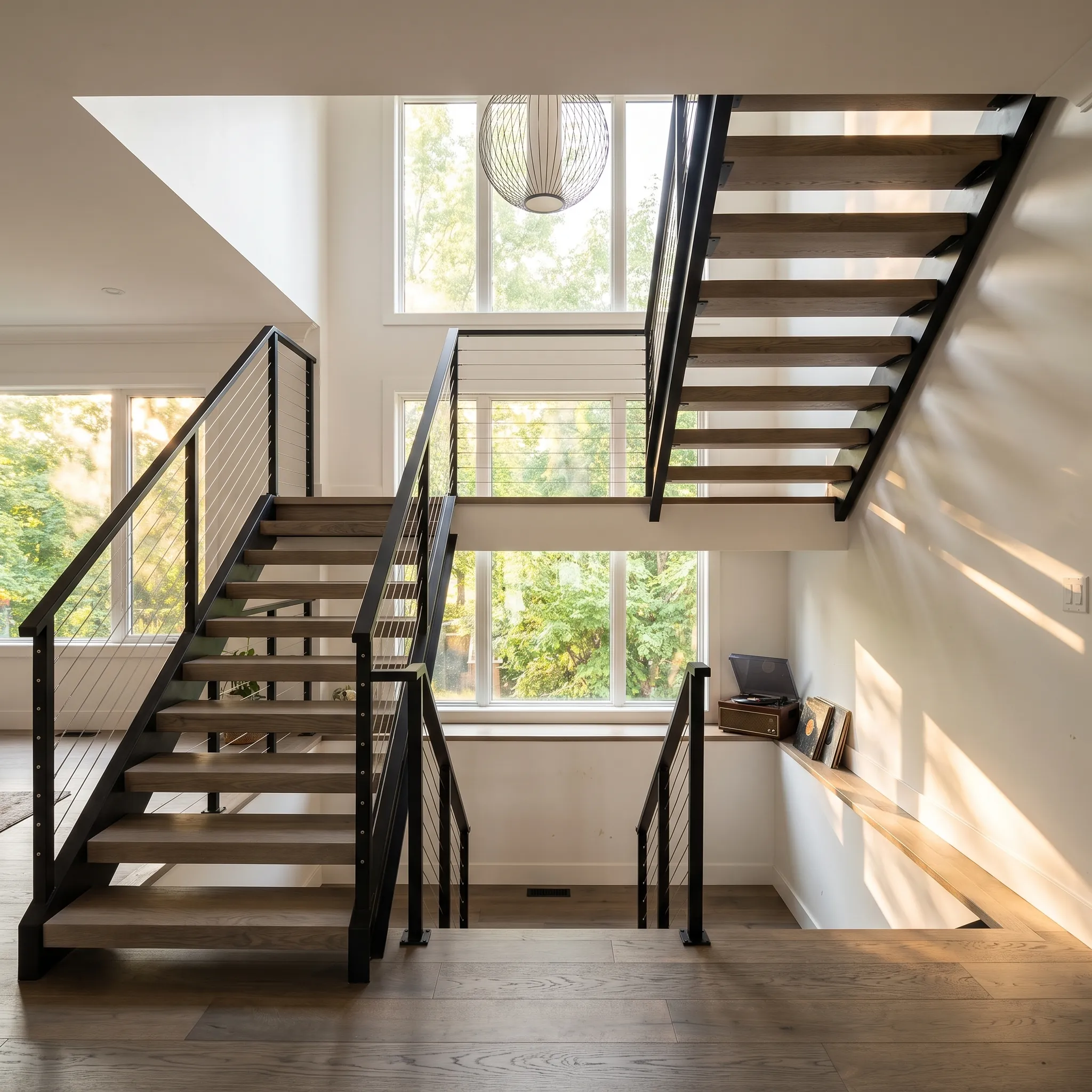
- Open-riser vs. closed-riser stairs: Newer Markham builds often feature open-riser staircases (no vertical riser board, floating tread look). These require a specific tread thickness and nosing profile. Not all flooring products work here — call us before ordering material if you have open risers.
- Matching main floor flooring: If you're refinishing stairs as part of a larger renovation that includes new main floor flooring, coordinate the two projects. Installing your main floor first, then doing the stair overlays, ensures a seamless species and finish match. Our installation team handles both in sequence.
Can You DIY Stair Refinishing?
Technically yes. Practically, it's one of the harder DIY flooring jobs. Here's the honest breakdown:
Sanding stairs by hand or with an orbital sander is feasible but slow. Drum sanders — the tool professionals use on floors — can't navigate stair geometry. You'll spend 3–4 hours per tread sanding by hand to get a smooth, even surface. On a 14-step staircase, that's 42–56 hours of sanding before you've applied a single coat of finish. Most homeowners who start this project hand it off to a professional by step 4.
Tread overlays are more DIY-accessible if you're comfortable with a miter saw and have experience with adhesive and finish nails. The risk is in the nosing cuts — the front edge of each tread needs a precise bullnose profile that requires either a router or pre-profiled tread stock. Mistakes here are visible from across the room.
Our honest recommendation: if you have more than 10 steps, hire it out. The labour cost is real, but so is the risk of a botched nosing or uneven finish on the most visible surface in your home. For a full breakdown of what professional installation costs in the GTA, see our 2026 cost guide.
Stair Refinishing vs. Full Replacement: When Each Makes Sense
Refinishing wins when: existing treads are solid hardwood, at least ¾" thick, structurally sound, and the look just needs updating. It's also the right call if you're selling the home and need to maximize return — a fresh stair finish adds perceived value at low cost.
Replacement (overlay or full) wins when: stairs are carpeted over plywood, treads have been sanded before and are too thin to sand again, there's visible cracking or structural damage, or you want a species change (e.g., going from pine to oak, or oak to hickory). If your main floor is getting new engineered hardwood anyway, matching the stair treads is almost always worth the incremental cost.
One thing that's never the right answer: painting stair treads as a long-term solution. Paint on a high-traffic horizontal surface chips within 6–12 months under normal use. We see this regularly on Markham homes where a previous owner tried to mask worn treads with floor paint. It buys time, not a solution.
Ready to fix the stairs?
Stair refinishing starts at $125 per step, new hardwood treads over existing stairs from $185 per step, and specialty steps (curved, landings, open risers) run $225 per step. Final pricing is confirmed after a site visit, so the fastest path is to book a free in-home measurement or send a photo of your staircase to (647) 428-1111. See finished projects and the full rate card on our stair refinishing page.
Frequently Asked Questions
How long does stair refinishing take in Markham?
A sand-and-recoat on a 13–16 step staircase takes 2–3 days total: one day for sanding and the first coat, one day for the second coat, and ideally a third day before heavy foot traffic. Oil-based finishes need an extra 24–48 hours of cure time. Engineered hardwood tread overlays are typically installed in a single day and can be walked on carefully the same evening once adhesive sets.
Do I need to leave my home during stair refinishing?
For oil-based polyurethane refinishing, yes — the fumes are strong enough that most families with children or pets stay elsewhere for 24–48 hours after the final coat. Water-based finishes have significantly lower VOCs and most families can stay home with windows open, though the stairs themselves will be out of service. Tread overlay installation produces no fumes and minimal dust — you can stay home throughout.
How many times can hardwood stairs be refinished?
A ¾" solid hardwood tread can typically be sanded 3–4 times over its lifetime, removing roughly 1/16" of wood per sand. If your stairs were installed in the 1990s and have never been refinished, you almost certainly have at least one more sand in them. If they've been done before, measure the tread thickness at the thinnest point (usually the nosing) — anything under ½" should get an overlay instead of another sand.
What's the difference between refinishing and resurfacing stairs?
These terms are sometimes used interchangeably, but technically: refinishing means sanding the existing wood and applying new coats of finish (stain + polyurethane). Resurfacing usually refers to installing new tread overlays on top of the existing structure — no sanding involved. Resurfacing is faster, produces no dust, and allows a complete species or colour change. Refinishing preserves the original wood and is typically less expensive if the treads are in good condition.
Can I refinish just the treads and not the risers?
Yes, and many homeowners do exactly this — refinishing or replacing treads in hardwood while painting risers white. It's a classic, clean look and it's less expensive than doing both in hardwood. The key is to do the riser paint after the tread finish is fully cured, so you don't get paint on your fresh polyurethane. If you're doing tread overlays, pre-primed MDF risers are a cost-effective and durable option.
Is stair refinishing worth it before selling a home in Markham?
Almost always yes. Worn or carpeted stairs are one of the first things buyers notice in a showing, and they mentally discount the asking price. A professional stair refinish or tread overlay on a 14-step staircase costs $600–$2,000 depending on method and material — and consistently returns more than its cost in perceived home value in the Markham market. It's one of the highest-ROI pre-sale upgrades we see.
Ready to get a number for your staircase? Call us at (647) 428-1111 or visit our showroom at 6061 Highway 7, Markham. We'll measure your stairs, check tread thickness, and give you a written quote — no obligation. Book your free in-home measurement online or walk in any day of the week.