Which Underlayment for Laminate Flooring? A Real Comparison
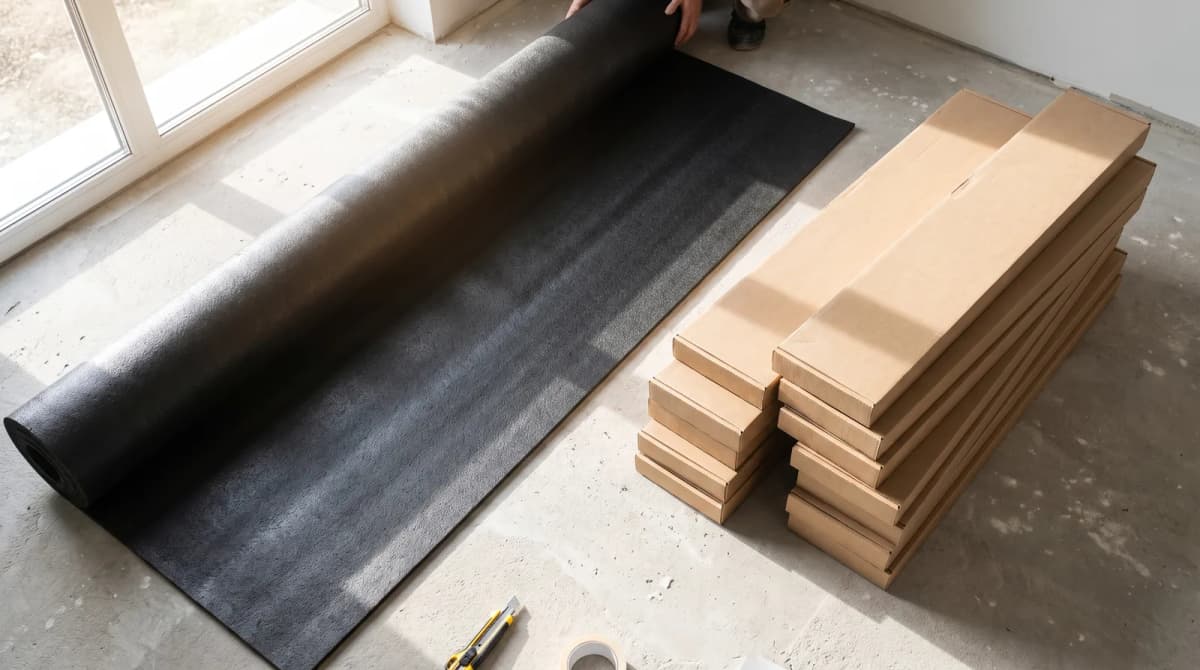
The right laminate underlayment depends on your subfloor and your building, not just your budget. Plywood over joists with no moisture concerns can run a basic foam pad. Concrete, basements, and condos need a built-in moisture barrier and, in condos, a real acoustic rating. Check first whether your laminate already has an attached pad. If it does, you're done, and adding more underneath will only cause problems.
Why the Underlayment Choice Matters More Than It Looks
It's tempting to treat underlayment as an afterthought: a cheap roll you grab on the way to the register with your flooring boxes. In practice it does three jobs at once: it cushions and quiets footfall, it can be the only thing standing between your subfloor's moisture and the laminate's wood-fibre core, and in a condo it's frequently the difference between a board approval and a rejected application. Getting it wrong doesn't usually show up on install day. It shows up as a noise complaint from the unit below, or a swollen seam eighteen months later, or a bylaw officer asking for paperwork you don't have. None of that is expensive to prevent up front.
First: Does Your Laminate Already Have an Attached Pad?
This is the step people skip and it costs them money. A growing share of laminate flooring, especially mid-to-premium lines, ships with a foam or cork pad pre-glued to the back of each plank. If yours does, stop here: adding a second underlayment on top is not a "better safe than sorry" move. It changes the click-lock geometry, can make joints unstable underfoot, and typically voids the flooring manufacturer's warranty outright. Flip a plank over and look before you add anything to your cart.
The Options We Stock, Side by Side
| Product | Thickness | Acoustic rating | Moisture barrier? | Best for | Price |
|---|---|---|---|---|---|
| Toucan 2.5mm White Foam | 2.5mm | IIC 52 / STC 66 | No | Budget laminate over plywood, no moisture concerns | $50.00/200 sq ft roll ($0.25/sq ft) |
| Toucan 3mm Black Acoustic | 3mm | IIC 72 / STC 73 | Built-in | Our pick, condos, basements, upper floors, laminate or vinyl | $70.00/200 sq ft roll ($0.35/sq ft) |
| Toucan 5mm Airflow Bubble | 5mm | IIC 72 / STC 73 | Built-in, dimpled air-gap | Max moisture protection, concrete/basement subfloors | $100.00/100 sq ft roll ($1.00/sq ft) |
| Roberts Serenity Foam | Standard | Basic foam, no rating listed | No | Plywood subfloors, pair with poly on concrete | $17.30/100 sq ft roll ($0.173/sq ft) |
| Roberts Unison 2-in-1 | Standard | Foam + moisture layer | Built-in | Floating vinyl and laminate over concrete | $32.20/100 sq ft roll ($0.322/sq ft) |
| Roberts First Step 3-in-1 | 2mm | Premium foam | Built-in | The laminate upgrade pad | $48.95/100 sq ft roll ($0.4895/sq ft) |
Our Default Recommendation: The 3mm Black Acoustic
For most GTA installs, whether it's a plywood main floor, a basement, or a condo, we point people toward the 3mm Black Acoustic Underpad. At IIC 72 / STC 73, it clears the acoustic bar for the vast majority of condo boards with real headroom, and the built-in moisture barrier means you're covered on concrete without buying a separate poly sheet. It's not the cheapest option in the lineup, but it's the one product that works across the widest range of subfloor and building situations without a second thought.
Concrete vs. Plywood vs. Condo: What Actually Changes
Plywood subfloor, no moisture concerns (a typical main-floor or upper-floor install over joists): the 2.5mm White Foam or Roberts Serenity Foam covers it. No vapour barrier needed since you're not sitting on concrete.
Concrete slab (basement, condo, or slab-on-grade main floor): you need a built-in moisture barrier or a separate 6-mil poly sheet underneath a non-barrier pad. Concrete continuously releases moisture vapour, and laminate's core is moisture-sensitive, skip this step and you risk swelling at the seams within a year or two.
Condo: add the acoustic requirement on top of the moisture requirement. Most condo boards specify a minimum IIC rating (commonly IIC 50) to limit impact noise transfer to the unit below, and some require documentation before you install. Confirm your building's specific number with the property manager, building requirements vary, and a board can ask you to rip up a floor that doesn't meet spec.
What Condo Boards Actually Ask For
Most GTA condo corporations require proof of a minimum Impact Insulation Class (IIC) rating before approving a flooring change, and it's common for property managers to ask for a copy of the underlayment's spec sheet as part of the approval package alongside your Certificate of Insurance and WSIB clearance for the installer. IIC 50 is a frequently cited minimum, though some newer or stricter buildings ask for IIC 55 or higher. Our 3mm Black Acoustic Underpad, tested at IIC 72 / STC 73, clears essentially every condo requirement we've seen with real margin, which matters, because a board that finds your underlayment falls short after the floor is already down can require you to pull it up and start over at your own cost.
If your building has a specific spec sheet requirement, ask us for the manufacturer's documentation before you install; we can provide it alongside your order so it's ready for the board submission rather than something you're chasing down after the fact.
Basement-Specific Considerations
A finished basement is concrete plus something else: cooler ambient temperature, less airflow than an above-grade room, and often a history of at least minor dampness even if there's no active leak. This is the scenario where skipping a moisture barrier causes the most damage over time, laminate's core is wood-fibre based and swells at the seams if moisture works its way up from below, even slowly. Pair a basement laminate install with either the 3mm Black Acoustic or 5mm Airflow Bubble underpad (both have a built-in barrier) rather than a basic foam pad, even if acoustic rating isn't a concern for your specific basement.
How Underlayment Affects Click-Lock Performance
It's not just moisture and sound, underlayment thickness and density change how the click-lock joint itself performs underfoot. Too soft or too thick a pad lets planks flex more than the locking mechanism was engineered for, which over time works joints loose and can cause visible peaking at the seams. This is part of why manufacturers spec a maximum underlayment thickness for their locking systems, and it's also the core reason attached-pad laminate can't take a second pad on top, you'd be stacking flex on flex. If a product doesn't list a compatible underlayment range, a mid-weight pad in the 2–3mm range is the safer default over anything thicker.
Installation Basics: Seams and Overlap
However you cut the underlayment, run rows in the same direction as your planks and butt the seams tight, don't overlap foam-only pads, since a doubled-up seam creates a ridge you'll feel underfoot. Products with a built-in moisture layer, like our 3mm Black Acoustic and the Roberts Unison and First Step lines, typically have a self-adhesive or overlap flap specifically for the vapour layer at the seam; follow the manufacturer's seam instructions on the roll rather than improvising, since the moisture barrier only works if the seams are actually sealed continuously across the room.
Quantity Math
Buy for your total square footage plus 5–10% for waste, trims, and cuts around doorways and closets. Since our rolls come in 100, 200, and 300 sq ft sizes depending on the product, do the math against roll size before checkout:
| Room size | 3mm Black Acoustic (200 sq ft rolls) | 5mm Airflow (100 sq ft rolls) |
|---|---|---|
| 300 sq ft | 2 rolls (400 sq ft, ~33% waste buffer) | 4 rolls (400 sq ft) |
| 500 sq ft | 3 rolls (600 sq ft) | 6 rolls (600 sq ft) |
| 800 sq ft | 5 rolls (1,000 sq ft) | 9 rolls (900 sq ft) |
Products We Stock
- 2.5mm White Foam Underpad (200 sq ft), $50.00
- 3mm Black Acoustic Underpad (200 sq ft), $70.00
- 5mm Airflow Bubble Underpad (100 sq ft), $100.00
- Roberts Serenity Foam Underlayment (100 sq ft), $17.30
- Roberts Unison 2-in-1 Underlayment (100 sq ft), $32.20
- Roberts First Step 3-in-1 Underlayment (100 sq ft), $48.95
Browse the full range at Underlay & Moisture Barriers, or run your room size through our quantity calculator.
Common Underlayment Mistakes
- Doubling up on an attached pad. Covered above, but worth repeating, it's the single most common mistake and the easiest to avoid by just checking the plank edge before you buy anything.
- Using a basic foam pad on concrete with no separate barrier. Roberts Serenity Foam has no vapour layer built in, fine on plywood, a real problem on a slab without adding poly underneath.
- Guessing at the condo acoustic requirement. Confirm the actual number in writing from your property manager rather than assuming a common figure like IIC 50 applies to your specific building.
- Buying underlayment before confirming subfloor type. Plywood and concrete call for genuinely different products, and returning a full roll of the wrong pad is an avoidable hassle.
- Leaving gaps or overlaps at seams. Even a small gap in coverage undermines both the acoustic performance and the moisture barrier across the whole room, not just at that seam.
Bring Us Your Floor Plan
If you're not sure whether your subfloor is plywood or concrete, or you need help confirming your condo's acoustic requirement, bring your floor plan into our Markham showroom and we'll match the underlay to the job before you buy anything. If your subfloor is concrete, also check our moisture barrier guide and self-leveling guide before you buy underlayment.
Pick up rolls at the showroom, or call (647) 428-1111 for a quote on materials or full installation.
Frequently Asked Questions
Do I need underlayment if my laminate already has an attached pad?
No, if your laminate has a factory-attached foam or cork pad on the back, adding a second underlayment on top voids most manufacturers' warranties and can actually make the click-lock joints unstable. Check the plank edge before you buy anything; attached-pad laminate is common on higher-end lines and it changes your whole materials list.
What underlayment should I use in a condo?
Condo boards typically require a minimum acoustic rating, most often IIC 50 or higher, to control impact noise for the unit below. Our 3mm Black Acoustic Underpad tests at IIC 72 / STC 73, well above typical condo minimums, and it doubles as a moisture barrier, which matters on a concrete condo slab. Always confirm your specific building's acoustic requirement before buying; some boards ask for documentation.
Do I need a separate moisture barrier under laminate on concrete?
If your underlayment doesn't already have a built-in vapour layer, yes. Our 3mm Black Acoustic and 5mm Airflow Bubble underpads both include a moisture barrier, so no separate poly is needed. Roberts Serenity Foam is a basic foam pad with no vapour layer, if you choose that one over concrete, pair it with a separate 6-mil poly sheet underneath.
What's the real difference between 2.5mm, 3mm, and 5mm underlayment?
Thickness alone isn't the story, it's what's built into the pad. Our 2.5mm White Foam is a budget standard for laminate over plywood with no major moisture concerns. The 3mm Black Acoustic adds a moisture barrier and a big jump in sound rating, making it our default pick for condos, basements, and upper floors. The 5mm Airflow Bubble is built for the toughest moisture situations, concrete slabs and basements, using a dimpled air-gap design for maximum protection.
How much underlayment do I need to buy for a 400 sq ft room?
Buy for the full room square footage plus about 5-10% waste for trims and cuts around doorways, so a 400 sq ft room needs roughly 420-440 sq ft of underlayment. Our rolls come in 100, 200, and 300 sq ft sizes depending on the product, so check roll size against your total before you check out.